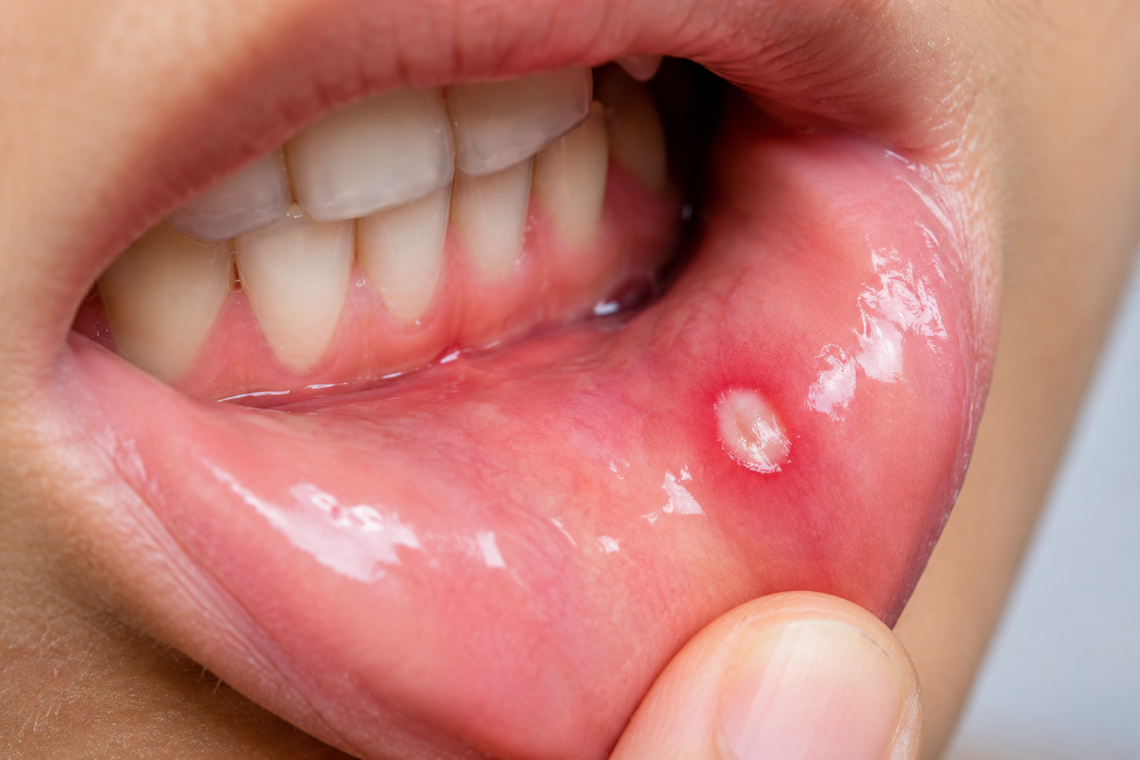
Have you ever developed a small, painful sore inside your mouth that seems to make eating, drinking, brushing your teeth, or even talking uncomfortable?
You’re not alone.
Mouth ulcers are common and usually appear as small, shallow sores with a white or yellowish center and a red border. They can develop inside the cheeks or lips, under the tongue, at the base of the gums, or on other soft tissues inside the mouth. Most ordinary canker sores heal on their own within one to two weeks.
But not every mouth sore is a canker sore.
A canker sore (aphthous ulcer) is different from a cold sore, which is usually caused by the herpes simplex virus and commonly appears on or around the lips. Canker sores are not contagious, while cold sores are contagious.
In this article, we’ll look at the common causes of mouth ulcers, ways to ease the pain at home, how to reduce the chance of getting them again, and when a sore needs to be examined by a doctor or dentist.
Important: Most mouth ulcers are harmless and heal without treatment, but a sore that lasts more than three weeks, keeps returning, becomes unusually large or painful, or is accompanied by other symptoms should be evaluated by a healthcare professional.
Canker Sores vs. Cold Sores
These two conditions are often confused because both can be painful.
Canker sores
Canker sores, also called aphthous ulcers, usually occur inside the mouth. They may appear on the inside of the cheeks or lips, under the tongue, or around the gums.
They are not contagious and commonly heal within one to two weeks. Larger or more severe ulcers can take considerably longer to heal.
Cold sores
Cold sores are caused by the herpes simplex virus. They commonly appear as small, fluid-filled blisters around the lips and mouth. They can spread from person to person, even when a visible sore isn’t present.
Antiviral treatment may help shorten cold-sore outbreaks, particularly when started early.
Because the causes and treatments are different, it’s important to know which type of sore you’re dealing with.
What Causes Mouth Ulcers?
In many cases, the exact cause of a canker sore isn’t known. Several factors can contribute, however, and different people may have different triggers.
Common triggers include:
- Stress, anxiety, or tiredness
- Minor injuries inside the mouth
- Accidentally biting your cheek, tongue, or lip
- Brushing too aggressively
- Braces, dentures, or other dental appliances
- A sharp or damaged tooth
- Certain toothpastes or mouthwashes
- Hormonal changes
- Certain foods
- Nutritional deficiencies
- Some medications
- Certain underlying medical conditions
Foods that may trigger or aggravate ulcers
Some people notice that certain foods make their mouth ulcers worse, including:
- Spicy foods
- Acidic fruits
- Tomatoes
- Chocolate
- Coffee
- Nuts
- Salty foods
- Very hot foods or drinks
- Hard or crunchy foods
This doesn’t mean everyone with mouth ulcers needs to avoid these foods permanently. Instead, pay attention to your own triggers.

Certain Medications Can Also Play a Role
Some medicines have been associated with mouth ulcers or dry mouth, including certain:
- NSAIDs and other pain relievers
- Beta-blockers
- Chemotherapy medications
- Some antibiotics
- Certain medications used for other chronic conditions
Never stop a prescribed medication on your own.
If your ulcers began soon after starting a new medicine, speak with your doctor or pharmacist. They can determine whether the medication might be contributing to the problem and whether there is a safer alternative.
Underlying Health Conditions
Frequent or unusually severe mouth ulcers can sometimes be associated with other medical conditions.
These may include:
- Iron, folate, vitamin B12, zinc, or other nutritional deficiencies
- Celiac disease
- Crohn’s disease
- Ulcerative colitis
- Behçet’s disease
- Certain immune-system disorders
- HIV or other causes of immune suppression
- Certain skin or inflammatory conditions
This is one reason why recurrent or unusually severe mouth ulcers should not always be treated as a simple nuisance.
Treating Mouth Ulcers at Home
Most ordinary mouth ulcers don’t require medical treatment and disappear on their own.
While you’re waiting for the ulcer to heal, however, there are several things you can do to reduce pain and irritation.
1. Rinse With Salt Water
A simple salt-water rinse can help soothe the mouth.
The NHS recommends dissolving ½ teaspoon of salt in a glass of warm water, rinsing your mouth with it, and then spitting it out rather than swallowing it.
You can repeat this as needed.

2. Try a Baking Soda Rinse
A baking-soda rinse may also help.
Mayo Clinic recommends dissolving 1 teaspoon of baking soda in ½ cup of warm water and using it as a mouth rinse.
Again, spit the solution out after rinsing.
3. Apply Cold
Cold can temporarily numb the area and reduce discomfort.
You can allow a small piece of ice to slowly dissolve over the sore or use a cold drink to help soothe your mouth.

4. Eat Soft, Cool Foods
When an ulcer is painful, choose foods that are easy to chew and unlikely to irritate the sore.
Try:
- Yogurt
- Soft fruits that don’t irritate you
- Soups that aren’t hot
- Porridge
- Soft rice dishes
- Smooth foods
Avoid very spicy, salty, acidic, hot, rough, or crunchy foods while the ulcer is healing.
5. Use a Soft-Bristled Toothbrush
A hard toothbrush can repeatedly irritate an existing ulcer.
Switch to a soft-bristled toothbrush and brush gently.
Good oral hygiene is still important, even when you have a mouth ulcer.
6. Consider an SLS-Free Toothpaste
Some people find that toothpaste containing sodium lauryl sulfate (SLS) aggravates recurrent canker sores.
If you regularly develop ulcers, trying an SLS-free toothpaste may be worth discussing with your dentist or trying as part of your routine. Both the NHS and Mayo Clinic include avoiding SLS-containing toothpaste among measures that may help some people.
7. Ask a Pharmacist About Mouth-Ulcer Treatments
If the pain is making it difficult to eat or drink, a pharmacist can recommend products designed to relieve symptoms.
Depending on your situation, these may include:
- Pain-relieving gels or sprays
- Antimicrobial mouthwash
- Saline mouthwash
- Protective mouth pastes
- Corticosteroid preparations for certain canker sores
For severe or persistent ulcers, a doctor or dentist may prescribe stronger treatments.
What About Honey, Basil, Celery, and Other Home Remedies?
You’ll find many traditional remedies online, including honey, basil leaves, celery, aloe vera, cinnamon, and other household ingredients.
Some may feel soothing, but evidence for many of these remedies is limited.
Rather than presenting them as proven treatments, I would treat them as optional comfort measures—and avoid anything that causes stinging or irritation.
In particular, don’t put harsh substances directly onto an ulcer simply because they’re described online as “natural.”
Natural doesn’t automatically mean safe or effective.
What Should You Avoid While the Ulcer Is Healing?
To make the healing process easier:
- Avoid spicy foods.
- Avoid acidic foods and drinks if they irritate you.
- Avoid very hot food and beverages.
- Avoid hard or crunchy foods that can scratch the sore.
- Avoid chewing gum if it irritates the area.
- Don’t pick, scrape, or bite the ulcer.
- Avoid aggressive brushing.
- Don’t smoke or use tobacco.
- Avoid alcohol if it irritates your mouth.
The goal is simple:
Don’t keep hurting the same spot while your body is trying to heal it.
How Can You Prevent Mouth Ulcers?
You can’t prevent every mouth ulcer, particularly when genetics or underlying health conditions are involved.
But these habits may reduce your risk:
Maintain good oral hygiene
Brush regularly with a soft toothbrush and floss gently.
Identify your triggers
Keep track of foods, medications, stress, hormonal changes, or other situations that seem to precede your outbreaks.
Eat a balanced diet
Make sure your diet provides adequate iron, vitamin B12, folate, zinc, protein, and other essential nutrients.
Protect your mouth
If you have braces, dentures, or a sharp tooth that repeatedly irritates the same area, ask your dentist to address it.
Manage stress
Stress appears to be a trigger for some people with recurrent canker sores. Finding healthy ways to manage stress may help reduce outbreaks.
Don’t smoke
If you smoke, quitting has many health benefits beyond reducing mouth irritation.

What Is Mouth Cancer?
This is an important subject to discuss without unnecessarily frightening people.
Most mouth ulcers are not cancer.
However, a mouth ulcer that doesn’t heal can sometimes be a sign of mouth cancer.
According to the NHS, an ulcer lasting more than three weeks should be examined. Other warning signs include a persistent red or white patch, a lump, ongoing mouth pain, or difficulty swallowing or speaking.
This doesn’t mean that every long-lasting ulcer is cancer.
It simply means:
Don’t ignore a sore that refuses to heal.
A dentist or doctor can examine it and determine what is causing it.
When Should You See a Doctor or Dentist?
Most mouth ulcers clear within one or two weeks.
You should arrange a medical or dental assessment if:
- The ulcer lasts more than three weeks.
- It keeps coming back frequently.
- It becomes unusually large.
- The pain is severe or difficult to control.
- It bleeds or becomes increasingly red and painful.
- You have difficulty eating or drinking.
- You develop fever or other symptoms.
- You have ulcers elsewhere on your body.
- The ulcer began after starting a new medication.
- You have a weakened immune system.
- You notice a persistent lump or red/white patch.
These symptoms don’t necessarily mean something serious is wrong, but they deserve proper evaluation.
Final Thoughts
Mouth ulcers can be surprisingly painful for something so small.
One tiny sore can make us dread eating, drinking, brushing our teeth, or even smiling.
The good news is that most ordinary canker sores are temporary and heal on their own.
The best approach is usually simple:
Keep your mouth clean, avoid irritating foods, protect the sore from further injury, manage your triggers, and give your body time to heal.
And don’t forget the most important part:
Know when a mouth ulcer isn’t behaving like an ordinary mouth ulcer.
If it lasts longer than three weeks, keeps returning, becomes unusually painful, or comes with other concerning symptoms, get it checked.
“Take care of your body. It’s the only place you have to live.”
“A cheerful heart is good medicine, but a crushed spirit dries up the bones.”
— Proverbs 17:22
Sometimes, we tend to ignore little health problems because we expect them to disappear on their own.
And most of the time, they do.
But taking care of ourselves means knowing when to wait, when to change a habit, and when to ask for help.
So, the next time a painful little ulcer appears, don’t panic.
Be gentle with yourself.
Give your mouth time to heal.
And remember that even the smallest signs from our body deserve our attention. ❤️
Sources
- https://www.nhs.uk/conditions/mouth-ulcers/
- https://www.mayoclinic.org/diseases-conditions/canker-sore/symptoms-causes/syc-20370615
- https://www.mayoclinic.org/diseases-conditions/canker-sore/diagnosis-treatment/drc-20370620
- https://www.nhs.uk/conditions/mouth-cancer/symptoms/
- https://www.ncbi.nlm.nih.gov/pmc/articles/PMC5066016/
Major Health And Fitness Benefits of Strength Training
Simple Ways To Maintain Stronger And Healthier Nails
Health Benefits of Drinking Black Coffee
Originally Published: Marc 3, 2020
Updated: August 2026





I love this article and will cherish it as a long time sufferer!
Thank you very much for your appreciation. Hope this article truly helps with your pursuance of optimal health and wellness.
I can be your friend xD