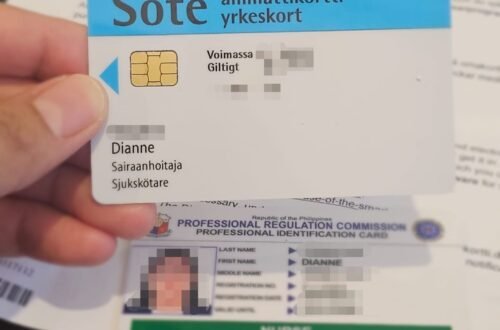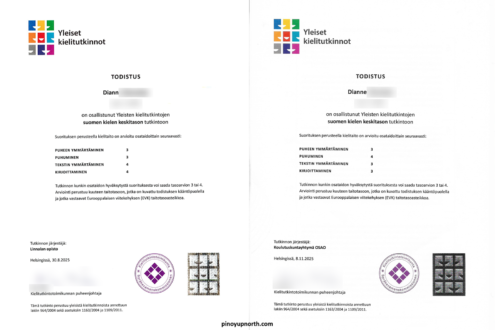
My Finnish Language Journey — Part 5C
There are some things in Finnish that I can understand perfectly when I see them written on paper.
Give me a sentence, my notes, and enough time to think, and I might be able to figure out which case ending, verb form, or consonant change I should use.
But put me in the middle of an actual Finnish conversation and ask me to answer immediately?
That is another story. 😂
Suddenly, all those grammar rules that looked familiar in my reviewer disappear from my brain.
In the previous part of this series, 12 Reasons Why Learning Finnish Was So Difficult for Me, I talked about some of the things that made Finnish challenging for me from the beginning, including consonant gradation, spoken Finnish, changing word forms, and translating thoughts from one language to another.
12 Reasons Why Learning Finnish Was So Difficult for Me
This time, I want to look a little more closely at the grammar itself.
These are not necessarily the hardest parts of Finnish grammar for everyone. They are simply the ones that still confuse me as a learner, especially when I need to use them quickly in a real conversation.
And yes – even after living in Finland and using Finnish in everyday life, I still make plenty of mistakes.
Actually, sometimes I realize my mistake immediately after the sentence has already left my mouth.
Too late. 😂
But that is also part of learning.


If you’re new to my Finnish language journey, you can start here:
Learning Finnish: The Beginning of My Language Journey
You can also read about how I first started learning the language while I was still working full-time in Dubai:
How I Started Learning Finnish While Working Full-Time in Dubai
Now, back to the grammar that continues to test my brain. 😅
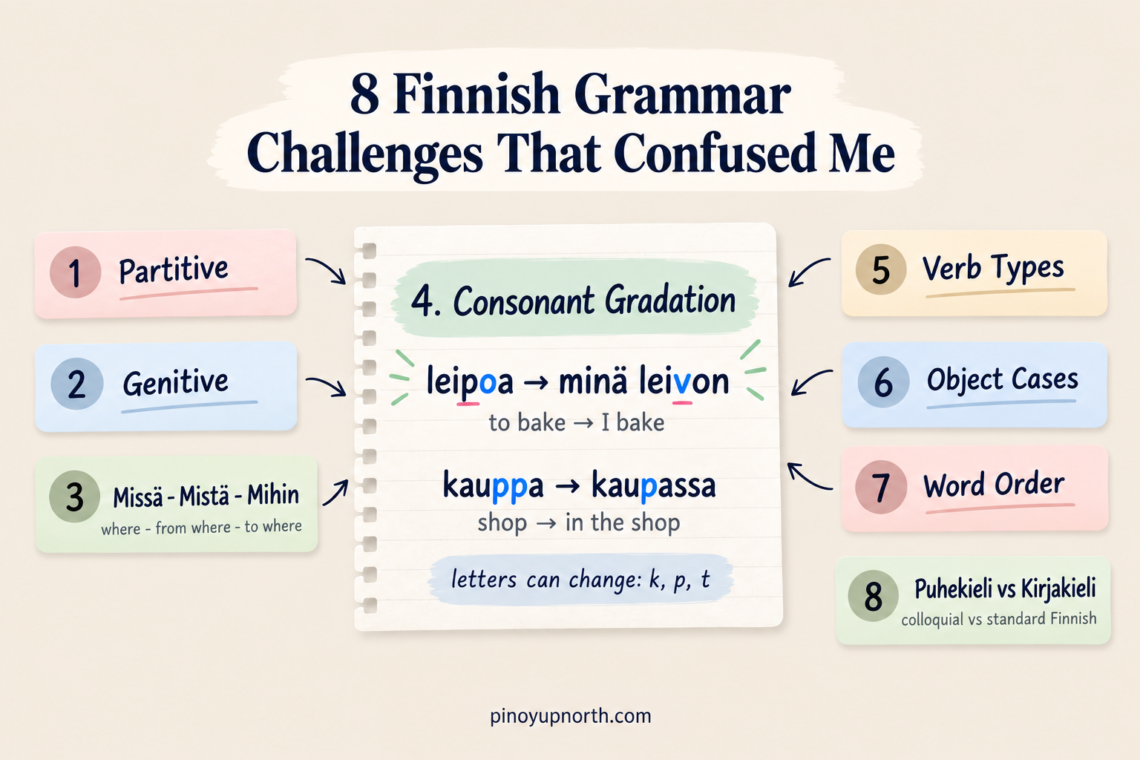
1. The Partitive Case
Ah, partitiivi.
We meet again. 😂
The partitive case confused me when I first started learning Finnish, and honestly, it can still confuse me now.
At one point, I thought of it too simply:
Positive sentence = probably no partitive.
Negative sentence = use partitive.
But Finnish had other plans. 😂
It is true that when an object is in a negative sentence, the object is generally in the partitive:
Syön omenan.
I eat/will eat the whole apple.
En syö omenaa.
I don’t eat/am not eating the apple.
But the partitive can also appear in an affirmative sentence, for example when the action is ongoing or incomplete, when we are talking about an indefinite amount, or with certain verbs that normally take a partitive object.
| Finnish | English | What I Notice |
|---|---|---|
| Syön omenan. | I eat/will eat the whole apple. | The apple is treated as a complete whole. |
| Syön omenaa. | I’m eating the apple / some apple. | The action or amount is not presented as complete. |
| En syö omenaa. | I don’t eat/am not eating the apple. | Negative object – partitive. |
| Rakastan sinua. | I love you. | Some verbs normally take a partitive object. |
And this is where my brain sometimes says:
But WHY?
😂
I can understand the explanation when I am studying it.
The challenge is choosing the correct form in the few seconds I have while speaking.
Sometimes I get it right.
Sometimes I don’t.
And sometimes I only realize afterward:
Oh… that should have been partitive.
2. The Genitive Case
Then there is the genitive.
The genitive is often recognizable because of the -n ending, and it can express relationships or possession. It also appears with nouns, pronouns, and adjectives, and in some sentence structures a total singular object appears in the genitive.
For example:
| Basic Form | Genitive Example | Meaning |
|---|---|---|
| lapsi | lapsen takki | the child’s jacket |
| minä | minun kirjani | my book |
| iso talo | ison talon ovi | the big house’s door / the door of the big house |
| auto | Ostin auton. | I bought the car/a car. |
On paper?
I can see it.
During a conversation?
Sometimes that little -n disappears somewhere between my brain and my mouth. 😂
It isn’t that genitive somehow disappears from spoken Finnish.
My problem is simply that when I need to respond quickly, I don’t always have time to consciously think:
Wait. Does this word need an -n?
Sometimes I say the sentence anyway, I realize afterward that something was missing, and the person I’m speaking with still understands what I meant.
Of course, I still want to improve it.
But I’ve also learned that communication doesn’t always have to stop just because I am unsure about one ending.
3. Missä, Mistä, Mihin – Where, From Where, and To Where
This trio…
Missä?
Mistä?
Mihin?
Always. Always. Always.
They confuse me. 😂
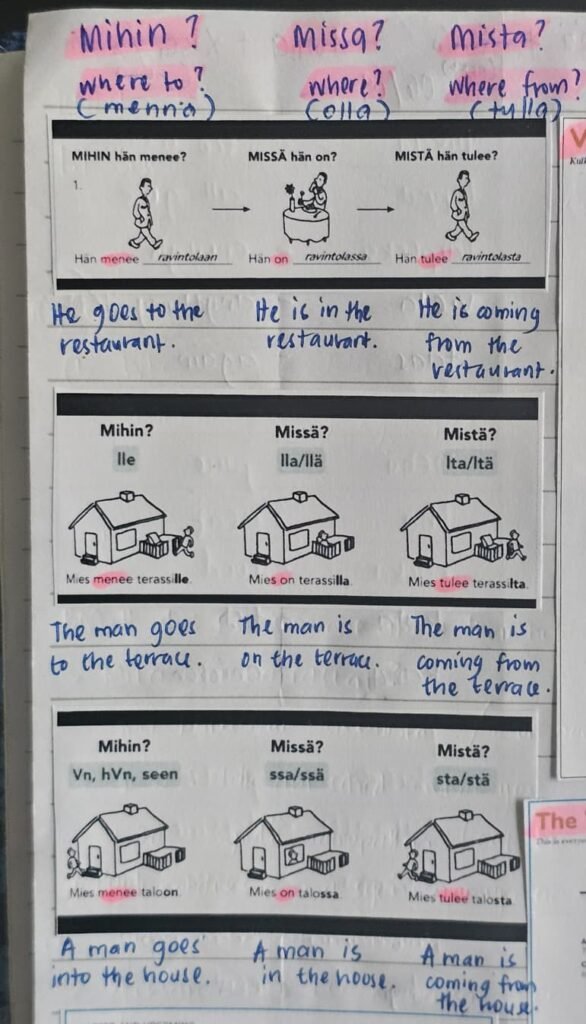
Finnish has both internal and external local cases. The basic three-way idea is location, movement away from somewhere, and movement toward somewhere. Finnish actually has six local cases forming three internal/external pairs.
A simple way I try to remember it is:
| Place | Missä? – Where? | Mistä? – From where? | Mihin? – To where? |
|---|---|---|---|
| ravintola | ravintolassa | ravintolasta | ravintolaan |
| talo | talossa | talosta | taloon |
| terassi | terassilla | terassilta | terassille |
So:
Olen ravintolassa.
I am in the restaurant.
Tulen ravintolasta.
I am coming from the restaurant.
Menen ravintolaan.
I am going to the restaurant.
Then:
Olen terassilla.
I am on the terrace.
Tulen terassilta.
I am coming from the terrace.
Menen terassille.
I am going to the terrace.
The problem isn’t only remembering the ending.
I also need to remember whether the word normally uses an internal form such as -ssa/-ssä, -sta/-stä, -Vn/-seen, or an external form such as -lla/-llä, -lta/-ltä, -lle.
And sometimes usage can depend on the particular place or meaning, which makes things even more interesting. 😅
4. Consonant Gradation
I already mentioned consonant gradation, or astevaihtelu, in Part 5B.
But it definitely deserves a place here too.
In Finnish, certain k, p, and t sounds can change when words are inflected. Common patterns include changes such as kk → k, pp → p, and other changes involving k, p, and t.
Here are some examples I practiced:
| Basic Form | Changed Form | What Changed |
|---|---|---|
| pankki | pankissa | kk → k |
| kauppa | kaupassa | pp → p |
| pöytä | pöydällä | t → d |
| silta | sillalla | lt → ll |
| apu | avulla | p → v |
| leipoa | leivon | p → v |
When I am looking at a table like this, it makes sense.
But during an interactive conversation in Finnish?
I often forget about consonant gradation completely.
😂
My brain is already busy trying to find the word, conjugate the verb, choose the case ending, understand what the other person just said, and somehow produce an answer before the conversation has already moved on.
There isn’t always enough time for my brain to say:
Hold on. We need consonant gradation here.
When I’m writing, I usually have more time to pause, think about the word, or check the correct form.
Speaking doesn’t give me that luxury.
5. Verb Types and Changing Verb Forms
Finnish verbs are another adventure.
I used to put many of these things together in my head as simply verb forms, although technically verb types and things such as tense, mood, and infinitive constructions are not exactly the same thing.
As a learner, though, they all created the same problem for me:
The verb I memorized kept changing.
😂
Take kirjoittaa, meaning to write:
| Form | Finnish | English |
|---|---|---|
| Dictionary form | kirjoittaa | to write |
| Present | kirjoitan | I write / I am writing |
| Past | kirjoitin | I wrote |
| Conditional | kirjoittaisin | I would write |
| -massa/-mässä construction | olen kirjoittamassa | I am in the process of writing |
Another example:
| Form | Finnish | English |
|---|---|---|
| Dictionary form | tehdä | to do / make |
| Present | teen | I do / make |
| Past | tein | I did / made |
| Conditional | tekisin | I would do / make |
| -massa/-mässä construction | olen tekemässä | I am doing / in the process of doing |
This is also where I learned that what I casually thought of as the Finnish “-ing form” wasn’t really a direct Finnish version of the English -ing.
There are different Finnish constructions depending on what you’re trying to say.
Again, I may know the rule when I have time.
But if someone asks me a question unexpectedly?
My brain might start going through the forms like:
Present? Past? Conditional? Which stem? Which ending? Help.
😂
And the longer I think, the more awkward the silence becomes.
So eventually, sometimes I just speak.
Correct or not.
Then I learn from it afterward.
6. Object Cases
This one deserves its own category because Finnish objects can be truly challenging.
Sometimes I know exactly what I want to say…
but I don’t know what form the object should take.
Genitive?
Nominative?
Partitive?
Plural?
And by the time I have answered all of those questions inside my head, the conversation might already be finished. 😂
Object choice in Finnish depends on several things, including whether the sentence is affirmative or negative, whether the object is understood as a whole or an indefinite amount, whether the action is completed or ongoing, and also the structure of the sentence itself.
Here is a simple table:
The Main Object Forms – A Simple Learner View
| Object Idea | Common Form | Example | Simple Meaning |
|---|---|---|---|
| Total singular | Genitive (-n) | Luin kirjan. | I read the book as a completed whole. |
| Total plural | Nominative plural (-t) | Luin kirjat. | I read the books. |
| Ongoing or partial singular | Partitive | Luin kirjaa. | I was reading the book / read part of it. |
| Indefinite or partial plural | Partitive plural | Luin kirjoja. | I read/was reading some books. |
| Personal pronoun object | Accusative (-t) | Näin sinut. | I saw you. |
This is only a simplified way of looking at it because object rules become more complicated depending on the sentence.
For example:
En lukenut kirjaa.
I didn’t read the book.
Because the sentence is negative, kirja becomes kirjaa.
But:
Lue kirja!
Read the book!
Here, the total object appears in the basic nominative form because of the sentence structure.
See why I get confused?
😂
Sometimes I use a partitive when another form would have been better.
Sometimes I make something plural when it shouldn’t be.
Sometimes I probably sound a little silly.
But at least I’m speaking Finnish.
And for me, that matters too.
7. Finnish Word Order
Compared with cases and verb forms, Finnish word order doesn’t scare me quite as much.
When I’m speaking as a learner, my first goal is usually:
Can I make the other person understand what I mean?
😂
Still, I try to put my words in a natural order because repetition helps me develop better habits.
Finnish word order is partly flexible, but changing the order can change what information is emphasized or presented as already known versus new.
Here are some simple examples:
| Finnish Sentence | Meaning / Focus |
|---|---|
| Minä syön omenan. | I eat/will eat the apple. A simple subject-verb-object structure. |
| Minä asun Helsingissä. | I live in Helsinki. |
| Auto on kadulla. | The car is on the street. The car is already the topic. |
| Kadulla on auto. | There is a car on the street. The sentence introduces the car. |
| Tänään menen töihin. | Today I’m going to work. The time is emphasized first. |
| Menen tänään töihin. | I’m going to work today. A neutral way of placing the time later. |
I don’t always stop myself in conversation just because I’m unsure whether my word order is perfect.
I try.
I make mistakes.
Then I listen to how other people say the same thing.
Sometimes I hear a phrase later and think:
Ahhh. THAT’S how I should have said it.
And hopefully my brain remembers it the next time.
That’s another reason I believe repetition is so important.
8. Puhekieli vs. Kirjakieli
For me, puhekieli, or spoken Finnish, remains more challenging than the standard Finnish I learned through lessons and written materials.
When I’m writing, I have time.
I can think about my answer.
I can read what I wrote again.
I can check my notes.
I can look at the sentence and ask myself:
Does this sound right?
But during a spoken conversation?
There is no edit button. 😂
Someone says something.
I need to understand it.
My brain needs to process it.
Then I need to find the Finnish words to answer.
Immediately.
Sometimes I stutter.
Sometimes I start a sentence and change it halfway through.
Sometimes I know the word, but somehow I can’t retrieve it from my brain quickly enough.
And sometimes I use a more formal form simply because that is the version I learned first.
For example:
| Standard Finnish | Common Spoken Form |
|---|---|
| minä olen | mä oon |
| sinä olet | sä oot |
| minulla on | mulla on |
Of course, there isn’t only one single form of spoken Finnish. Everyday speech varies between regions, communities, situations, and speakers. Standard Finnish is only one form of the language, while Finland also has many different spoken varieties.
I have noticed something encouraging, though.
The more I hear puhekieli and the more I use Finnish in real conversations, the less strange it feels.
My brain is slowly becoming more familiar with it.
Something that once sounded incredibly fast starts becoming recognizable.
A shortened word that once confused me starts sounding normal.
A phrase I used to translate inside my head becomes something I understand without translating every single word.
Very slowly…
but it happens.
And that brings me back to what I keep telling myself:
Practice really is the key.
Follow My Finnish Language Journey
This article is part of my Finnish Language Journey series, where I share my personal experience learning Finnish before and after moving to Finland.
Main Article – Learning Finnish: The Beginning of My Language Journey
Part 5A – How I Started Learning Finnish While Working Full-Time in Dubai
Part 5B – 12 Reasons Why Learning Finnish Was So Difficult for Me
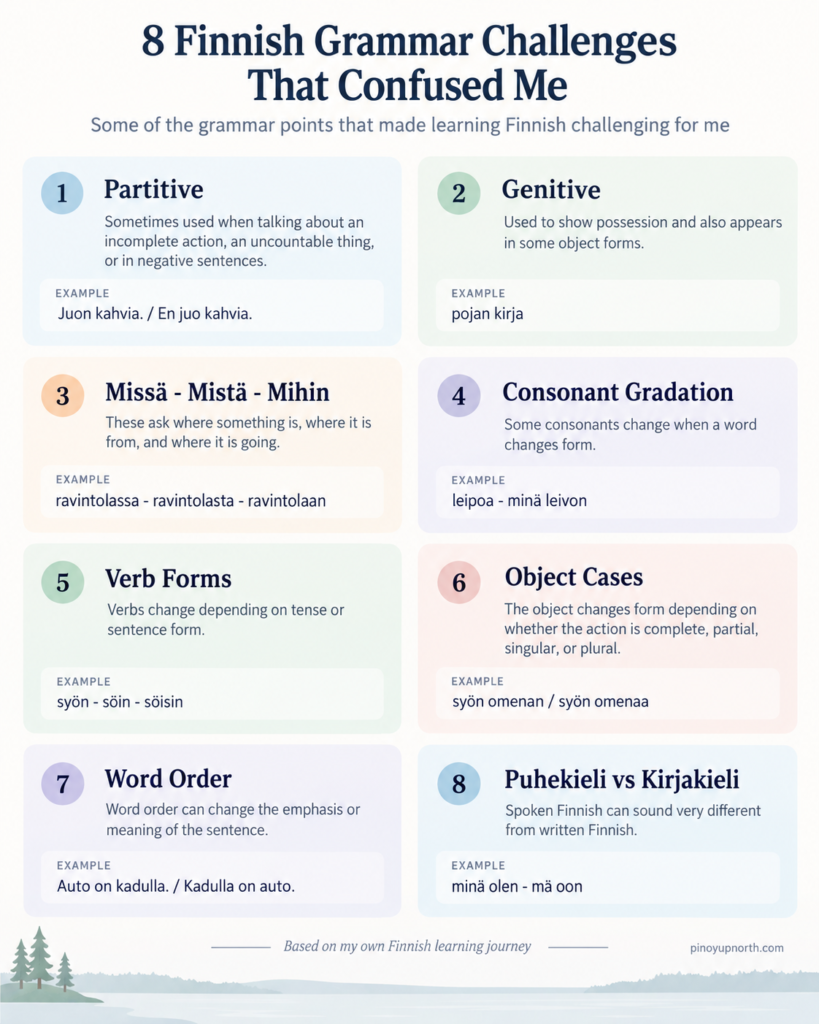
Part 5C – 8 Finnish Grammar Challenges That Still Confuse Me
Part 5D – Finnish Words I Still Struggle to Pronounce
Part 5E – 12 Things That Helped Me Improve My Finnish
Final Thoughts
When I formulate Finnish sentences, especially during a real conversation, I sometimes skip many of these things.
The partitive.
The genitive ending.
The correct local case.
Consonant gradation.
The perfect verb form.
The right object case.
Natural word order.
And sometimes the spoken version of the word completely surprises me.
😂
But I don’t think the answer is to wait until my Finnish grammar becomes perfect before I speak.
Grammar is important. I still want to learn it, practice it, and use it correctly.
But I have also learned not to let grammar become the reason I am afraid to open my mouth.
Most of the Finnish people I have personally spoken with – at work, in shops, around our neighborhood, and in other everyday situations – have been patient with me.
Sometimes I know my sentence isn’t grammatically perfect.
Sometimes an ending is missing.
Sometimes I use the wrong case.
But very often, the conversation still continues.
They understand enough of what I’m trying to say, and I understand a little more because I had the courage to try.
And when I don’t understand?
I can simply say:
Anteeksi, voitko sanoa uudestaan?
Sorry, can you say that again?
Or:
En ymmärtänyt. Voitko sanoa uudestaan?
I didn’t understand. Can you say that again?
There is nothing wrong with asking.
I think confusion will always be part of learning something new.
Actually, maybe confusion isn’t the opposite of learning.
Sometimes confusion is simply the place where learning begins.
So I will keep making mistakes.
I will keep correcting myself.
I will keep listening.
And most importantly, I will keep speaking.
Speak. Practice. Repeat.
“Grammar helps me build the sentence, but courage helps me say it.”
- Pinoy Up North
“A wise man will hear, and will increase learning; and a man of understanding shall attain unto wise counsels.”
- Proverbs 1:5, KJV
Learning a language has taught me that understanding a rule and being able to use that rule naturally are two very different things.
Sometimes my brain knows the grammar, but my mouth hasn’t caught up yet.
And that’s okay.
Every conversation gives me another chance to practice. Every mistake gives me something to remember. Every time I understand a little more than I did before, that is progress.
Maybe fluency isn’t built by waiting until we are confident enough to speak.
Maybe confidence is built because we keep speaking even while we are still learning.
One word at a time.
One sentence at a time.
One conversation at a time.
Puhu. Harjoittele. Toista. 🇫🇮💚