My YKI Test Journey — Part 6H
I’ve already taken the Finnish YKI test twice.
I’ve already experienced the nervousness before the exam, the pressure during it, the long wait for the results…
and thankfully, the relief of finding out that I passed.
Twice. 💚
So if somebody asked me today:
“If you had to take the YKI test again, what would you do differently?”
My answer wouldn’t be:
Study more grammar.
Memorize thousands more words.
Buy more books.
Or try to make my Finnish perfect.
Instead, the first thing I would change would be something much more practical.
I would practise listening much more.
Not only because listening was personally the most difficult part of the YKI test for me.
But because after the exam, I realized something even more important:
Listening is one of the Finnish skills I need the most in my everyday life.
And sometimes, understanding the question correctly can make all the difference between giving the right answer…
and giving an answer that makes absolutely no sense. 😂
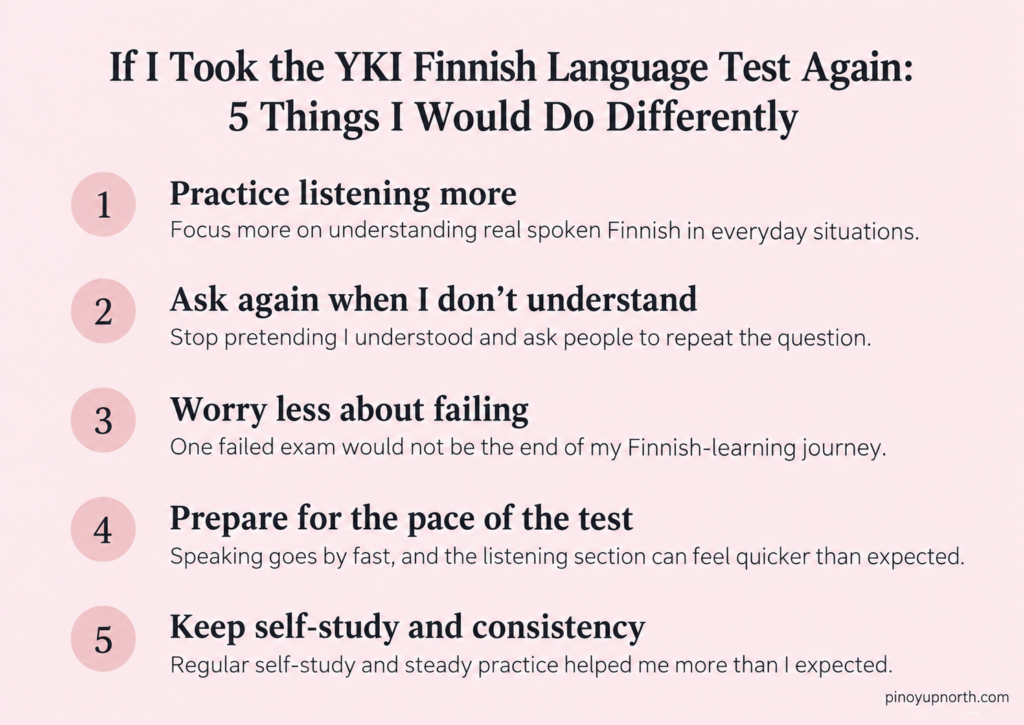
1. I Would Practise Listening Much More
If I took YKI again, listening would receive the biggest part of my attention.
In my previous post about the reading and listening tests, I shared how difficult listening was for me.
The Finnish kept moving.
I couldn’t stop the speaker.
I couldn’t ask:
“Anteeksi, vielä kerran?”
And if I missed one important word, I sometimes lost the meaning of the whole sentence.
Official intermediate-level YKI practice materials also show why listening requires concentration. Depending on the task, recordings may be heard once or twice, and the test includes multiple-choice, true-or-false and open-ended questions.
Source: Yleiset kielitutkinnot
But now that I’ve finished the exam, I don’t think listening practice is important only because of YKI.
I need it every day.
I speak Finnish with my colleagues.
At the grocery store.
At restaurants.
With my neighbors.
During appointments.
When someone calls me.
When someone suddenly asks me something that I wasn’t expecting.
And before I can answer correctly, I first need to understand:
What did this person actually say to me?
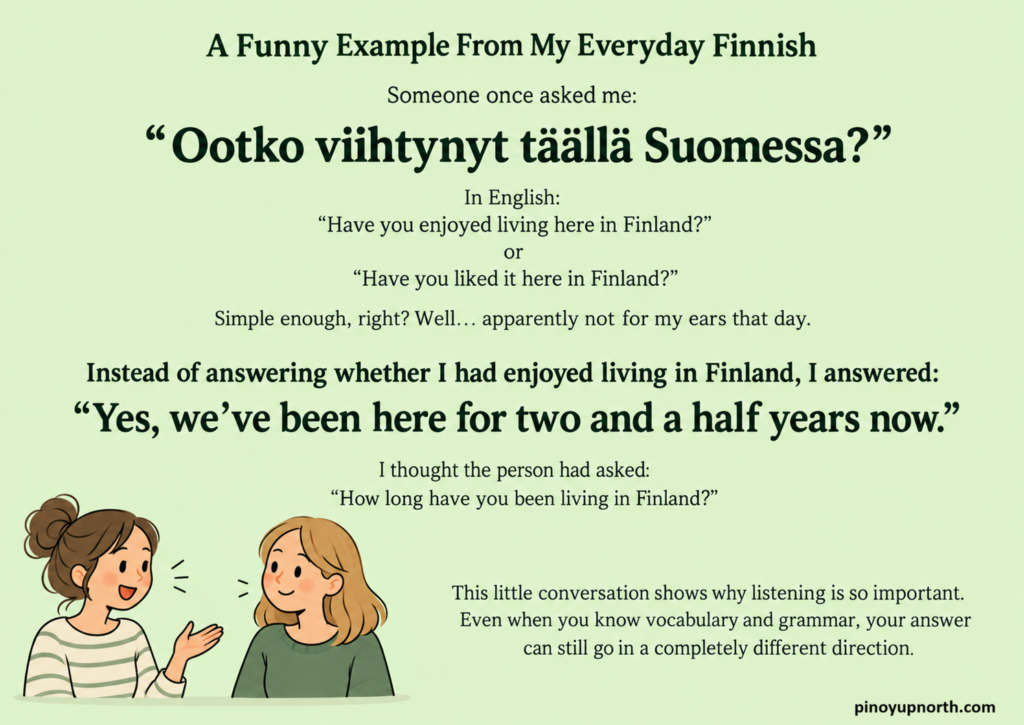
A Funny Example From My Everyday Finnish
This actually happened to me.
Someone once asked me:
“Ootko viihtynyt täällä Suomessa?”
Basically:
“Have you enjoyed living here in Finland?”
or
“Have you liked it here in Finland?”
Simple enough, right?
Well…
apparently not for my ears that day. 😂
I misunderstood what the person had asked.
Instead of answering whether I had enjoyed living in Finland, I answered something like:
“Yes, we’ve been here for two and a half years now.”
😂😂😂
Completely different question.
In my head, I thought the person had asked:
“How long have you been living in Finland?”
So technically my answer wasn’t completely random…
It was just answering a question that nobody had actually asked me. 😅
And that little conversation perfectly explains why listening is so important.
You might know enough Finnish to answer.
You might know the vocabulary.
You might even know the grammar.
But if you misunderstand the original question?
Your answer can still go in a completely different direction.
2. I Would Stop Pretending That I Understand
This is something I’m still learning to do.
Sometimes someone speaks to me in Finnish and I don’t completely understand.
And instead of saying:
“Anteeksi, voitko sanoa uudestaan?”
I smile.
I nod.
And somewhere inside my head I’m thinking:
Okay… what did this person just say? 😂
Then I try to guess.
Sometimes the guess works.
Sometimes…
well, you get answers like:
“We’ve been here for two years.” 😅
If I could go back to my earlier Finnish-learning self, I would tell her:
ASK AGAIN.
If you didn’t understand, ask.
If the person spoke too quickly, ask them to repeat it.
If one word confused you, ask what it means.
For a long time, one thing stopped me from doing that:
I worried that the other person might become impatient.
Maybe they would get tired of repeating themselves.
Maybe they would think:
Why doesn’t she understand me?
But my experience living in Finland has generally taught me something different.
Most people I’ve spoken with have been patient when they realize I’m still learning Finnish.
And really…
asking someone to repeat themselves is much better than pretending to understand and then answering something completely unrelated. 😂
So if I were preparing for YKI again, I wouldn’t only practise listening through exercises.
I’d practise real listening.
Conversations.
Normal-speed Finnish.
Puhekieli.
Podcasts.
Television.
News.
Workplace conversations.
And most importantly, I would stop being afraid to admit:
“Sorry, I didn’t understand. Can you say that again?”
Because that’s part of learning too.

3. I Would Spend Less Time Worrying About Failing
This is probably another big thing I would change.
Before my first YKI test, I worried so much about failing.
And after the test?
I worried even more. 😅
I replayed questions in my mind.
I remembered answers I wasn’t confident about.
I thought about things I should have said differently.
I convinced myself that I had probably failed certain parts.
Eventually, that anxiety contributed to me booking my second YKI test before I had even received the results of the first one.
And then my first certificate arrived.
I had passed.
That experience changed my perspective.
Would failing have been disappointing?
Of course.
Would taking another test have cost more money, time and effort?
Absolutely.
But failing one examination would not have meant:
My Finnish-learning journey was over.
I could continue studying.
I could practise.
I could register for another YKI test when needed.
In fact, I personally ended up taking YKI twice anyway, and current official YKI information even provides instructions for people who have participated on multiple test dates.
Source: Opetushallitus
So if I took the test again, I would try to spend less energy thinking:
What if I fail?
and more energy thinking:
What can I do with the Finnish I know right now?

I Would Worry Less About Perfect Grammar Too
I would also stop spending so much time worrying about:
perfect grammar,
perfect pronunciation,
and memorizing as many Finnish words as possible.
Of course, grammar matters.
Vocabulary matters.
Pronunciation matters.
We need all of them.
But trying to learn everything before taking YKI?
Impossible.
Finnish is a language.
You don’t finish learning an entire language before one Saturday morning examination. 😅
Even now, I still learn new Finnish words.
I still make grammatical mistakes.
I still pronounce some things incorrectly.
And there are still conversations where I need someone to repeat something.
That’s normal.
So instead of chasing perfect Finnish, I would tell myself:
Prepare well. Do your best. Use the Finnish you already know.
Passing the test comes after that.
4. I Would Prepare More for How Fast the Test Feels
One thing that surprised me during YKI was how quickly some parts seemed to pass.
The clearest example for me was speaking.
In my 2025 examination, I remember that part lasting only around 24 minutes.
Twenty-four minutes.
That’s not very long.
But during those minutes, you’re listening to instructions, thinking, preparing, responding and trying to show what you can do in Finnish.
And suddenly…
it’s finished.
I remember thinking:
That’s it?
Those few minutes become part of the assessment of your speaking ability.
That surprised me.

I Also Expected the Listening Part to Sound Slower
Listening surprised me in another way.
Before taking YKI, somewhere in my mind I expected the Finnish in the listening section to be slower.
Maybe because I was still learning the language, I imagined the recording would sound more like Finnish created specifically for learners.
Slow.
Clear.
Easy to separate word by word.
Then the test started.
And I remember thinking:
Wait… why are they speaking so fast? 😂
It felt much faster than I had expected.
That’s another reason why, if I took YKI again, I would listen to much more normal-speed Finnish beforehand.
Not only simplified learner material.
I would expose myself to natural conversations and practise understanding the main idea, instead of trying to translate every single word.
Official YKI guidance actually tells candidates before the examination to listen and try to speak the language as much as possible, and during the test to listen carefully to the instructions and try to answer every task.
Source: Yleiset kielitutkinnot
That advice makes much more sense to me now that I’ve actually taken the test.
Sometimes understanding a few important keywords was enough to help me figure out what was happening.
And on test day, those keywords helped me more than trying to mentally translate every sentence.

5. I Would Continue Self-Study – Because It Helped Me More Than I Expected
One thing I wouldn’t change?
Self-study.
If anything, I would continue doing even more of it.
I had language courses.
I had teachers.
I attended online lessons through work.
All of those things helped me build and polish my Finnish skills.
I’m grateful for them.
But when I think about what personally made one of the biggest differences in my YKI preparation…
it was the work I did on my own.
Answering reviewers.
Practising writing.
Listening.
Speaking out loud.
Studying vocabulary.
Going through my YKI books.
Making notes.
Repeating the things I didn’t understand.
Using practice questions.
Trying again after making mistakes.
Self-study allowed me to focus on the areas I personally struggled with.
If I had difficulty with something, I could stay with it longer.
If I already understood something, I could move forward.
And perhaps most importantly:
I had to take responsibility for my own learning.
A teacher can explain something.
A course can provide materials.
A book can give exercises.
But eventually…
I still have to learn it.
Consistency Helped More Than Studying Perfectly
This connects to something I’ve mentioned throughout this series:
Consistency.
I didn’t have perfect study days every day.
Sometimes I was working.
Sometimes I was tired.
Sometimes family responsibilities came first.
Sometimes I studied for a long time.
Sometimes I could only do a little.
But I kept coming back to Finnish.
Again.
And again.
And again.
That mattered more than having one perfect study session.
If I were preparing for YKI again, I would still choose regular self-study over trying to cram everything shortly before the examination.
Even 20 or 30 minutes of focused practice can be useful if you’re doing it consistently.
What I Would Tell My Earlier Self
If I could sit beside the version of myself who was preparing for her first YKI test in August 2025, I think I would tell her:
Keep learning.
You don’t need to know everything today.
One mistake is not the end of the world.
You will make mistakes.
You will survive them.
Focus.
Not on the person beside you.
Not on the question you think you answered incorrectly five minutes ago.
Focus on the task in front of you.
Listen more.
Don’t only learn how to speak Finnish.
Learn how to really hear it.
Ask when you don’t understand.
You don’t need to pretend.
Work hard and stay consistent.
Even when progress feels slow.
And finally:
It will be worth it.
At that time, I didn’t know what my results would eventually look like.
I didn’t know that I would take the test twice.
I didn’t know that I would pass both times.
I only knew that I had to continue.
Looking back now, I’m glad I did.
Follow My YKI Test Journey
This article is part of my My YKI Test Journey series, where I share my personal experience preparing for and taking the Finnish YKI test.
Main Article – My YKI Test Journey
Part 6A – What Is the YKI Test?
Part 6B – How I Prepared for the YKI Test
Part 6C – YKI Speaking Test
Part 6D – YKI Writing Test
Part 6E – YKI Reading and Listening Test
Part 6F – What I Found Most Difficult About YKI
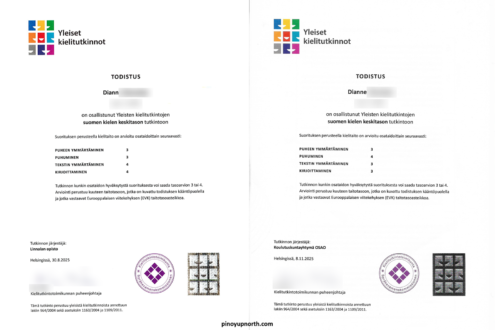
Part 6G – My YKI Test Results
Part 6H – 5 Things I Would Do Differently
You can also follow the Finnish-learning journey that came before YKI:
→ Learning Finnish: The Beginning of My Language Journey
→ My Finnish Language Journey Series
Final Thoughts
If I took the YKI test again, I wouldn’t try to become a completely different Finnish learner.
I wouldn’t throw away everything I did and start over.
A lot of what I did worked.
The self-study helped.
The reviewers helped.
My language courses helped.
Speaking Finnish in everyday life helped.
And most importantly, continuing even when Finnish felt difficult helped.
But I would change where I placed my attention.
I would listen more.
I would expose myself to more normal-speed Finnish.
I would ask people to repeat themselves instead of pretending I understood.
I would worry less about failing.
I would stop expecting myself to remember every grammar rule and every Finnish word I had ever studied.
And I would remind myself that one mistake doesn’t decide an entire examination.
Perhaps that’s the biggest lesson I can take from the whole experience.
YKI isn’t only about how much Finnish you have memorized.
It’s also about learning how to use what you know when you need it.
And that skill doesn’t end when the examination is over.
I still need it every day.
At work.
At the grocery store.
At appointments.
With friends.
With neighbors.
And apparently…
when somebody asks me whether I’ve enjoyed living in Finland and I accidentally tell them how many years I’ve lived here. 😂
I’m still learning.
And that’s okay.
Passing YKI didn’t mean that my Finnish-learning journey was finished.
It simply showed me how far I had already come.
There is still much more to learn.
So if I could give my earlier self – or anyone preparing for YKI now – one final reminder, it would be:
Keep listening. Keep learning. Keep going.
You don’t need perfect Finnish to continue moving forward. 💚
“You don’t have to understand everything at once. Keep listening, keep learning, and keep going.”
“Wherefore, my beloved brethren, let every man be swift to hear, slow to speak, slow to wrath:”
- James 1:19 (KJV)
Important: This post describes my personal experience with the intermediate-level Finnish YKI examination in 2025. The timings, pace, difficulties and strategies I describe are based on my own examinations and shouldn’t be treated as a guarantee of what another YKI test will feel like. Test arrangements and official instructions may change, so always check the latest information from the Finnish National Agency for Education and official YKI materials before taking the examination.
Sources
- Finnish National Agency for Education – After the YKI Test – official information about YKI results and certificates, including information for people who have participated in YKI more than once. Opetushallitus
- University of Jyväskylä / Centre for Applied Language Studies – Intermediate-Level Listening Comprehension – official examples showing the different listening task types and how recordings may be played once or twice depending on the task. Yleiset kielitutkinnot
- University of Jyväskylä / Centre for Applied Language Studies – Instructions for Test Participants – official guidance encouraging candidates to listen and speak the language as much as possible before the test, follow instructions carefully and attempt every task.