My Finnish Language Journey — Part 5D
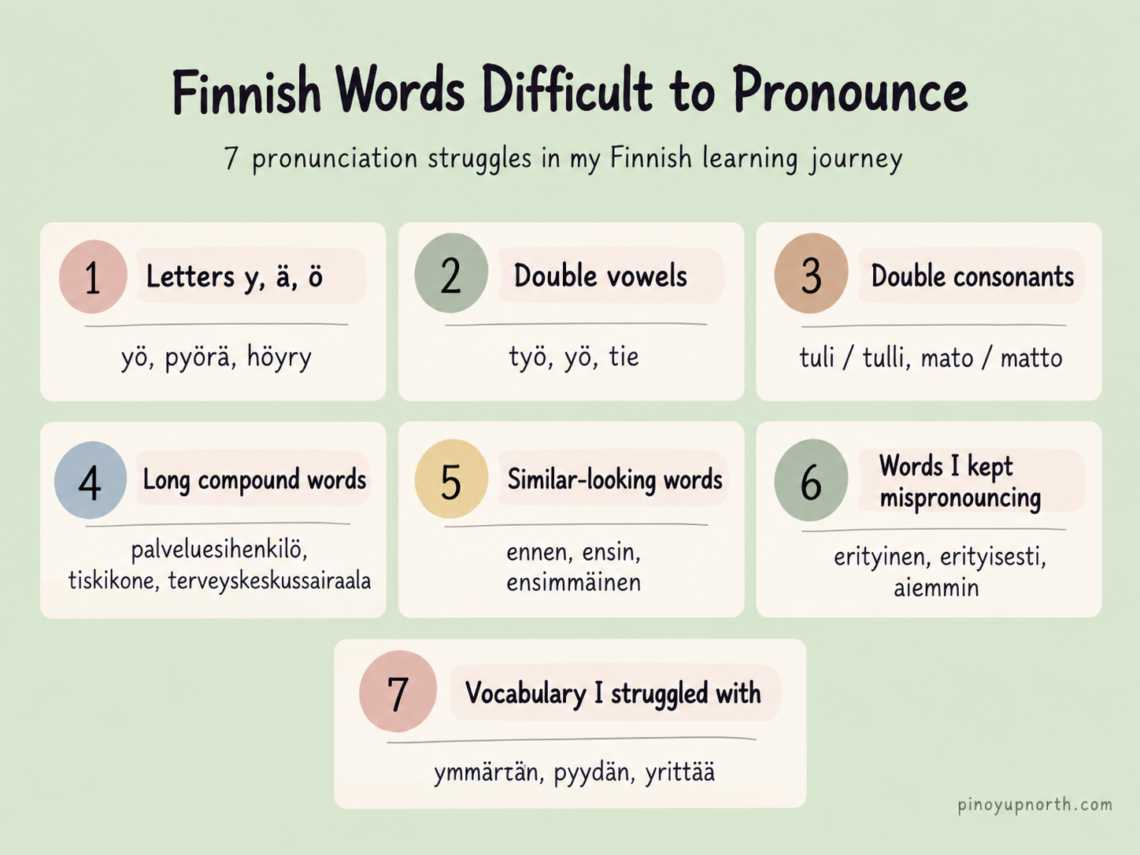
Some Finnish words are easy for me to recognize when I see them written down.
Then I try to say them out loud.
And suddenly, my mouth and my brain are no longer working together. 😂
When I first started learning Finnish, I actually liked that many words are pronounced quite consistently with how they are written. But that didn’t automatically make pronunciation easy for me.
There were completely new vowel sounds to learn, long vowels that I kept shortening, double consonants that I didn’t emphasize enough, and eventually some very long compound words that seemed to have no ending at all.
Even now, there are Finnish words that I sometimes need to slow down and say carefully.
And just like with grammar, I have learned that knowing a word and being able to say it naturally during a conversation are two very different things.
1. The Finnish Alphabet Looked Familiar – Until I Started Speaking
Finnish uses the Latin alphabet, so when I first looked at written Finnish, many of the letters were already familiar to me.
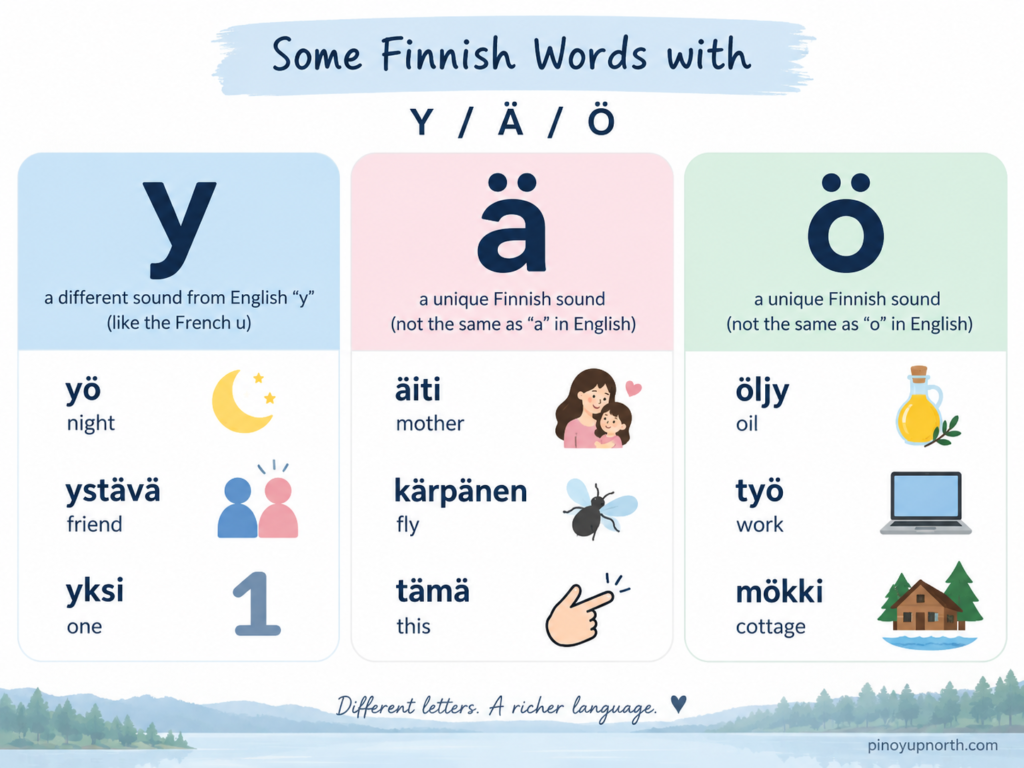
But compared with the English alphabet, Finnish also has å, ä, and ö at the end of its alphabet. The letter y isn’t an additional letter – English has it too – but its Finnish pronunciation is very different from the English y.
For me, y, ä, and ö were among the sounds that took a lot of getting used to.
| Letter | Finnish Example | English | What Made It Difficult for Me |
|---|---|---|---|
| y | tyyny | pillow | Finnish y doesn’t have a direct English equivalent. The lips are rounded while the tongue stays toward the front. |
| ä | päivä | day | It needed to stay clearly different from Finnish a. |
| ö | yö | night | Another rounded front vowel with no direct equivalent in English. |
| y + ö | työ | work | Two unfamiliar sounds appearing together in one short word! 😂 |
| y + ö | hyöty | benefit | This combination took a lot of practice for me to say naturally. |
Finnish ä is fairly close to the vowel in English hat in many accents, while y and ö do not have exact English equivalents.
Words such as työ, yö, pyörä, and hyöty looked so short.
But short did not always mean easy. 😂
2. Double Vowels – One Letter Longer, One Sound Longer
Then came the double vowels.
This was another adjustment for me because I was used to English, where two written vowels can behave in many different ways.
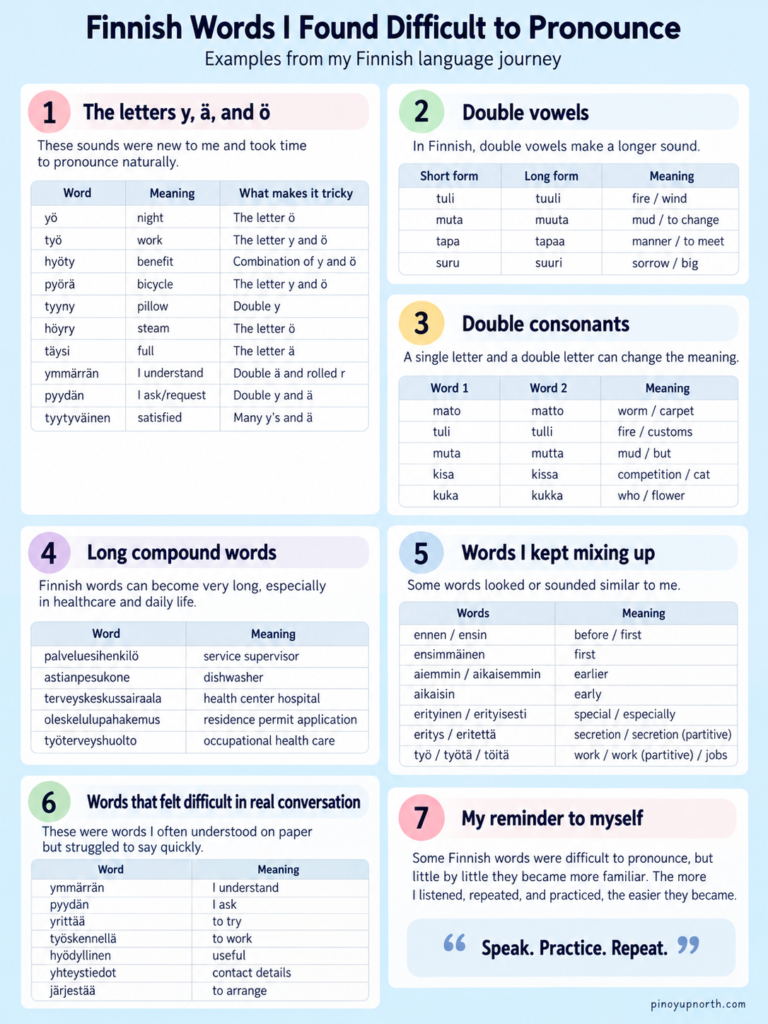
In Finnish, when the same vowel is written twice, such as aa, ee, ii, oo, uu, yy, ää, or öö, it normally represents a long vowel sound. Finnish also distinguishes long and short sounds, so shortening a vowel can sometimes produce a different word or meaning.
At the beginning, I often said the long vowel too quickly.
My eyes could see two letters.
My mouth apparently decided that one was enough. 😂
| Shorter Form | Meaning | Longer Form | Meaning |
|---|---|---|---|
| tuli | fire | tuuli | wind |
| tapan | I kill | tapaan | I meet |
| sata | one hundred | sataa | it is raining |
| muta | mud | muuta | other / something else |
This taught me that the second vowel isn’t simply there for decoration.
I actually need to hold the sound longer.
It may feel like a tiny difference when you’re learning, but to a Finnish speaker, that difference can matter.
3. Double Consonants – I Had to Learn to Pause a Little
Double consonants gave me the same problem.
When Finnish writes kk, pp, tt, ss, ll, and other doubled consonants, the consonant is longer than a single one. Distinguishing a short consonant from a long one can distinguish words.
For me, this felt almost like holding the consonant for a tiny moment before continuing.
| Single Consonant | Meaning | Double Consonant | Meaning |
|---|---|---|---|
| kuka | who | kukka | flower |
| muta | mud | mutta | but |
| kisa | competition | kissa | cat |
| tuli | fire | tulli | customs |
When I spoke too quickly, I sometimes forgot to give the double consonant enough length.
And then I realized that I might technically be saying a completely different word. 😂
So I started trying to listen more carefully whenever Finnish people spoke.
Not just to what they were saying, but also to how long they held certain sounds.
4. Then Came the Long Finnish Compound Words
And just when I thought individual words were challenging enough…
Finnish started connecting words together. 😂
Finnish has many compound words, and some of them can become quite long.
One thing that helped me was to stop looking at the whole word as one giant collection of letters.
Instead, I started looking for the smaller words inside it.
| Finnish Word | Break It Into Parts | English |
|---|---|---|
| palveluesihenkilö | palvelu + esi + henkilö | service supervisor / manager |
| astianpesukone | astian + pesu + kone | dishwasher |
| terveyskeskussairaala | terveys + keskus + sairaala | health centre hospital |
| työvuorosuunnittelu | työ + vuoro + suunnittelu | work-shift planning |
| päivystyspoliklinikka | päivystys + poliklinikka | emergency clinic / emergency department |
| henkilöllisyystodistus | henkilöllisyys + todistus | identity document |
And yes – I corrected one of my old versions here.
I used to think of astianpesukone as something like astiantiskikone. 😅 The correct word is astianpesukone – literally built from words connected with dishwashing and a machine.
Finnish words normally carry their main stress on the first syllable, and that also applies to compound words, although compound parts can have secondary stress.
Breaking long words into smaller pieces helped me enormously.
Instead of seeing:
terveyskeskussairaala
I could see:
terveyskeskus + sairaala
Suddenly, it wasn’t one impossible word anymore.
It was two words I already knew.
5. Finnish Words I Repeatedly Said Wrong
Some of my pronunciation struggles weren’t necessarily caused by long words.
Sometimes several words simply looked too similar to me.
These were some that repeatedly made me stop and think:
| Finnish | English | Why It Confused Me |
|---|---|---|
| työ | work | Very short, but the y + ö combination was difficult. |
| työtä | work – partitive singular | Now I had y, ö, and ä in one word. 😅 |
| töitä | work / jobs – partitive plural | Similar meaning, completely different-looking middle. |
| ennen | before | The double n needed to be heard. |
| ensin | first / first of all | Easy for me to mix up with ennen. |
| ensimmäinen | first | Longer form with double m. |
| aiemmin | earlier / previously | The vowel sequence plus double m confused me. |
| aikaisemmin | earlier / previously | Longer version that took practice. |
| aikaisin | early | Looked similar to aikaisemmin but wasn’t the same word. |
| erityinen | special | I had to slow down when saying it. |
| erityisesti | especially | Even longer – and easy for my tongue to get lost. 😂 |
| eritys | secretion / the act of secreting | Very different meaning despite looking similar to erityinen. |
| eritettä | secretion / discharge | Partitive form of erite, a word I encountered in healthcare. |
One group that especially caught me out was:
erityinen – erityisesti – eritys – erite – eritettä
They look close enough that my learner brain wanted to put them in the same box.
But they don’t mean the same thing.
Erityinen means special and erityisesti means especially. Eritys refers to secretion as a process, while erite refers to a secreted substance, and eritettä is its partitive form.
Imagine trying to choose the right one quickly while speaking at work. 😂
6. Some Words My Mouth Needed Extra Practice With
Then there were words that simply needed repetition.
Not because they were necessarily advanced, but because they contained combinations of Finnish sounds that weren’t natural for me yet.
Instead of trying to pronounce the whole word at once, I sometimes broke it into smaller syllables.
| Finnish | English | How I Break It Down |
|---|---|---|
| yö | night | yö |
| hyöty | benefit | hyö-ty |
| pyörä | bicycle | pyö-rä |
| tyyny | pillow | tyy-ny |
| höyry | steam | höy-ry |
| täydellinen | perfect / complete | täy-del-li-nen |
| tyytyväinen | satisfied | tyy-ty-väi-nen |
| ymmärrän | I understand | ym-mär-rän |
| pyydän | I ask / request | pyy-dän |
| yrittää | to try | y-rit-tää |
Look at this combination:
tyytyväinen
😂
When I first saw words like that, my eyes knew there was a word in front of me.
My mouth just wasn’t sure what to do with it.
But after hearing the same words repeatedly at work, in conversations, in lessons, and in everyday life, they slowly became less intimidating.
That’s something I have noticed again and again with Finnish.
A word can look impossible the first time.
Then you hear it ten times.
You say it twenty times.
You use it in a real conversation.
And eventually, it simply becomes another word you know.
7. I Don’t Try to Sound Perfect Anymore
Of course, I still want to pronounce Finnish correctly.
Vowel and consonant length can genuinely affect meaning, so these aren’t things I want to ignore completely.
But I also don’t want pronunciation to stop me from speaking.
Sometimes my y isn’t perfect.
Sometimes my double consonant is too short.
Sometimes I start a long Finnish word, lose my way somewhere in the middle, and somehow still reach the ending. 😂
And that’s okay.
If someone doesn’t understand me, I can repeat it.
If I hear somebody pronounce the word differently, I can listen and try again.
That is how so much of my Finnish has improved – not by getting every word perfect before using it, but by actually using the language.
Continue My Finnish Language Journey
This article is part of my Finnish Language Journey series, where I share my personal experience learning Finnish before and after moving to Finland.
Main Article – Learning Finnish: The Beginning of My Language Journey
Part 5A – How I Started Learning Finnish While Working Full-Time in Dubai
Part 5B – 12 Reasons Why Learning Finnish Was So Difficult for Me
Part 5C – 8 Finnish Grammar Challenges That Still Confuse Me
Part 5D – Finnish Words I Still Struggle to Pronounce
Part 5E – 12 Things That Helped Me Improve My Finnish
Final Thoughts
Learning how to pronounce Finnish has reminded me that sometimes progress isn’t something you notice immediately.
A word that feels impossible today may become completely normal after hearing and using it often enough.
I still pronounce things incorrectly.
I still occasionally repeat a word because the first attempt didn’t sound right.
And there are still moments when I see a long Finnish word and think:
Okay… where do I even start? 😂
But now I know where to start.
Slow down.
Break the word into smaller pieces.
Listen.
Say it again.
And most importantly, don’t be afraid to use it.
Pronunciation does matter, especially in Finnish where the length of a vowel or consonant can sometimes change the meaning of a word.
But perfection doesn’t have to come before communication.
For me, it has been the other way around.
I started communicating first.
Then, little by little, my pronunciation began catching up.
And I’m still learning.
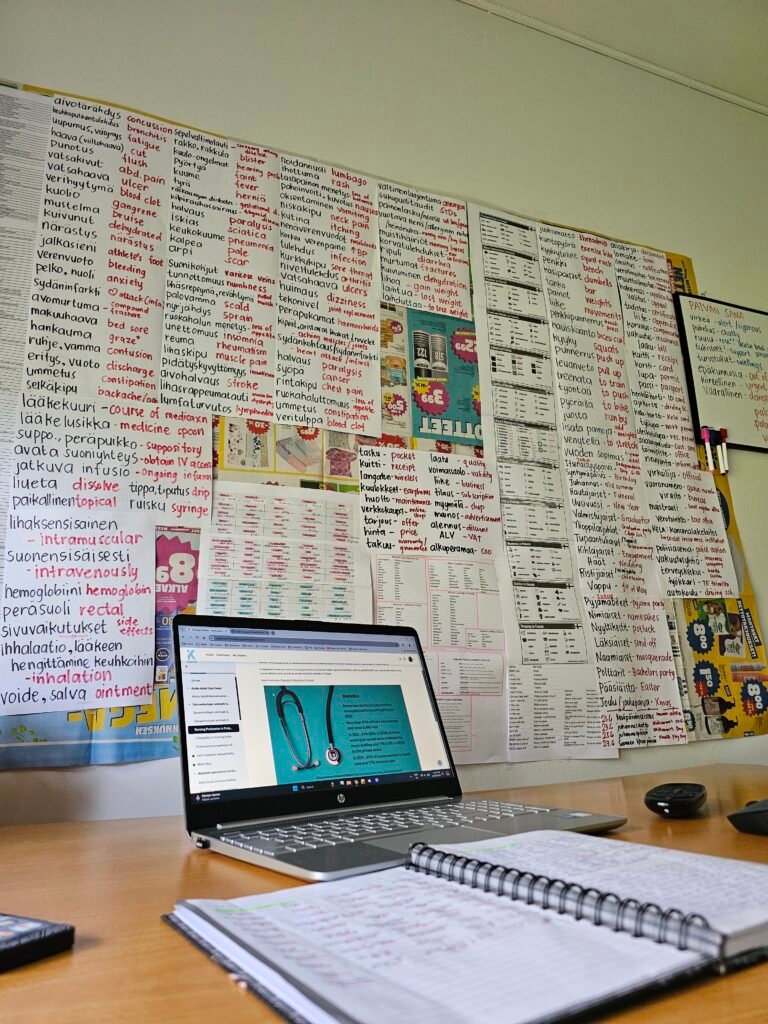
“A difficult word becomes less frightening every time I dare to say it.”
- Pinoy Up North
“The heart of the wise teacheth his mouth, and addeth learning to his lips.”
- Proverbs 16:23, KJV
Sometimes learning a language feels as though we are teaching not only our brain, but also our ears and our mouth.
We have to hear a new sound.
Remember it.
Teach our mouth how to make it.
Then somehow produce it quickly enough during a real conversation.
That doesn’t happen overnight.
Some words took me many tries. Others needed months of hearing them before they finally started feeling natural.
But every time I say a word that once seemed impossible, I’m reminded that repetition really does work.
Maybe I won’t pronounce every Finnish word perfectly.
But I’ll keep listening.
I’ll keep saying them.
And eventually, one difficult word at a time, they won’t feel quite so difficult anymore. 💚🇫🇮