My YKI Test Journey — Part 6C
Of all the parts of the YKI test, speaking – puhuminen – was one of the sections that made me the most nervous.
It wasn’t only about knowing Finnish.
You had to listen.
Understand what was being asked.
Think of an answer.
Find the right words.
Organize your thoughts.
And then actually speak – all within a limited amount of time.
There wasn’t much room to sit quietly and construct the perfect Finnish sentence inside my head.
You simply had to respond.
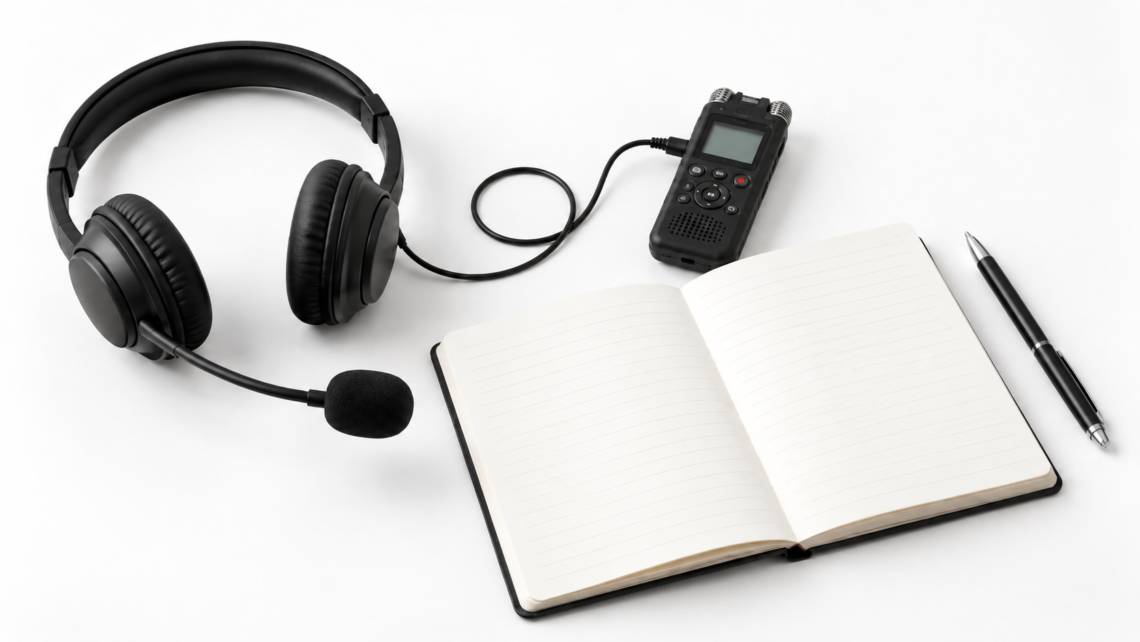
When I took the intermediate Finnish YKI test in 2025, the speaking part lasted around 24 minutes in my examination. The setup involved headphones, a microphone, a task booklet, and recorded instructions. Other test locations and arrangements may vary, but the Finnish National Agency for Education explains that speaking and listening are usually completed in a language lab.
Source: Opetushallitus
Looking back, I think this part taught me one of the most important lessons from my entire Finnish-language journey:
Your Finnish does not have to be perfect before you speak.
Sometimes you simply have to speak anyway.
What the Speaking Test Was Like for Me
During my examination, we were seated in the same room with other test takers.
I had my own place to sit, with a headset and microphone.
We were also given a booklet containing the tasks and instructions.
I could hear the recorded instructions through my headphones while following the questions in the booklet.
Then came the difficult part.
After hearing the prompt, there was only a limited amount of preparation time before I had to speak.
Those few moments became very important.
I tried to quickly write down:
keywords,
useful vocabulary,
the main points I wanted to say,
and anything that might help me build my answer.
Then I would hear the signal to begin.
And that was it.
Speak.
Official YKI practice materials show the same general idea: different speaking tasks have their own preparation and speaking times, and candidates can use preparation time to make notes before responding.
Source: Yleiset kielitutkinnot
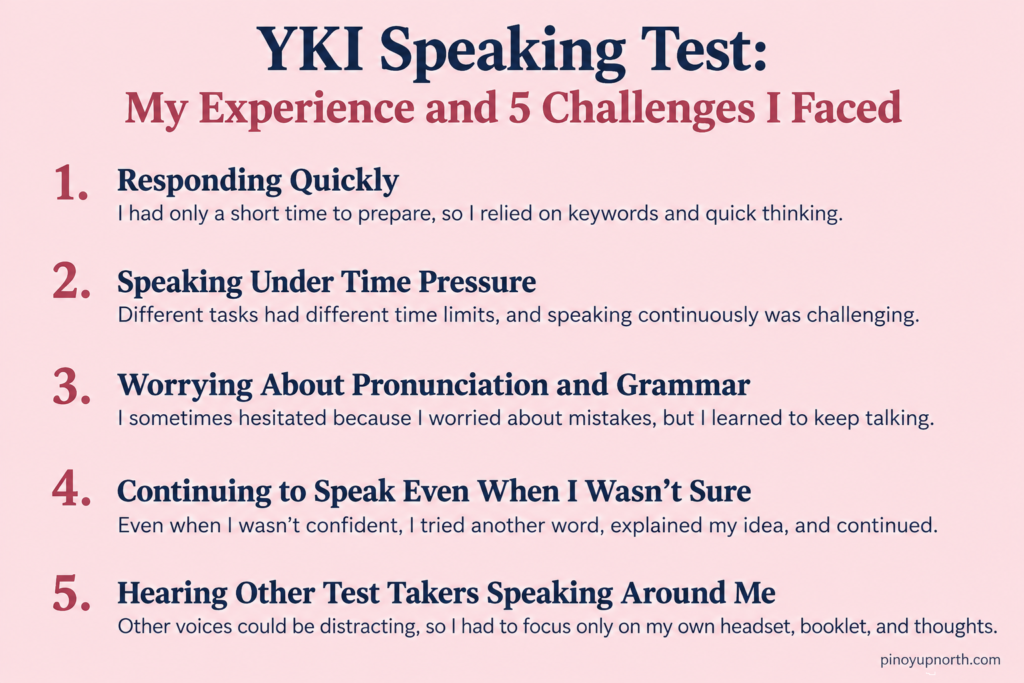
5 Challenges I Faced During the YKI Speaking Test
1. Responding Quickly
This was probably one of the biggest challenges for me.
Once the question or situation was presented, I had only a short amount of time to prepare.
My brain needed to work fast.
What exactly are they asking?
What should I say first?
What vocabulary can I use?
How can I explain this in Finnish?
I tried to avoid writing complete sentences during preparation because there simply wasn’t enough time.
Instead, I wrote keywords.
For example, if I needed to give an opinion, I might quickly think of:
my opinion,
two or three reasons,
an example,
and a conclusion.
Then I would build my sentences while speaking.
This was something I had practised at home, and I’m glad I did.
2. Speaking Under Time Pressure
Knowing Finnish is one thing.
Speaking Finnish while watching the clock is something else. 😅
Different speaking tasks give you different amounts of time.
The longer mielipide, or opinion task, was especially challenging for me because I had to speak continuously for around two minutes.
Official intermediate-level YKI practice materials also show an opinion task with two minutes of speaking time, where the test taker chooses a topic, gives an opinion and explains the reasons behind it.
Source: Yleiset kielitutkinnot
Two minutes might not sound very long.
But try speaking for two straight minutes in a language you’re still learning.
Suddenly…
two minutes feels very long. 😂
You need enough ideas to keep talking without becoming completely lost halfway through.
My goal was to have a simple structure in my mind:
Introduce the topic → give my opinion → explain why → give examples → finish my thought.
It wasn’t always perfect, but having some kind of structure helped me continue.

3. Worrying About Pronunciation and Grammar
This was another problem I created for myself.
Sometimes I became hesitant because I was thinking:
Was that grammar correct?
Did I pronounce that word correctly?
Should I use this ending or that ending?
But then I realized something.
If I spent too much time worrying about every grammatical ending, I would stop talking.
And stopping completely wasn’t going to help me.
Official YKI speaking assessment considers the overall performance, including areas such as fluency, coherence, range and accuracy of expression, pronunciation, and grammatical structures. The assessment is based on the performance as a whole rather than one single criterion.
Source: Opetushallitus
That helped reinforce something I had already learned from everyday Finnish:
Making a mistake does not mean the entire conversation has failed.
If the other person can understand what you’re trying to say, keep going.
Correct yourself if you can.
If not, continue.
4. Continuing to Speak Even When I Wasn’t Sure
There were moments during the test when I wasn’t completely sure whether my answer was good.
Maybe I wasn’t sure if I understood the question correctly.
Maybe I knew what I wanted to say but couldn’t remember the exact Finnish word.
Maybe my sentence started one way and then somehow ended somewhere completely different. 😅
But I kept talking.
This became almost like my personal rule:
Speak anyway.
The official YKI test-day guidance actually encourages candidates to attempt every task and answer every question. Official speaking practice materials similarly remind test takers to say something in every task and to stay on the assigned topic.
Source: Opetushallitus
That matched exactly how I approached the test.
If I said nothing, there would be nothing to evaluate.
So even when I wasn’t confident about my Finnish, I tried to give the evaluator something that showed what I could do.
I spoke.
I explained.
I tried another word.
I continued.
5. Hearing Other Test Takers Speaking Around Me
This is something I wasn’t fully prepared for.
Because we were taking the speaking test in the same room, I could sometimes hear other students speaking.
Imagine this:
You’re trying to remember what you wanted to say.
You’re searching inside your brain for a Finnish word.
Then suddenly you hear somebody nearby answering their own task.
And your brain goes:
Wait… what was I saying again? 😂
That was genuinely distracting for me.
Sometimes another person was still speaking while I was already trying to prepare my next answer.
And this is where I discovered another very important skill:
Focus.
I had to learn to ignore the voices around me and concentrate only on:
my headset,
my booklet,
my question,
and my own thoughts.
Easier said than done.
But during the test, I kept reminding myself:
Don’t listen to them. Their test is not your test.
How I Practised for the Speaking Test
Thankfully, speaking wasn’t something I began practising only on examination day.
My everyday life in Finland had already become part of my training.
I used Finnish at work with colleagues, patients and supervisors.
I used it in shops.
I used it around our neighborhood.
I used it whenever I had an opportunity.
But I also did a lot of speaking practice by myself.
Yes.
I talked to myself. 😂

Talking to Myself Actually Helped
Sometimes I stood in front of a mirror and answered Finnish questions.
Sometimes I recorded myself on video.
Sometimes I picked a question from my reviewers and answered it without preparing first.
I even made small handmade review cards.
I wrote questions on small pieces of paper, mixed them up and picked one randomly.
Then I would answer.
The goal wasn’t to produce perfect Finnish.
The goal was to train my brain to:
see a topic → think quickly → start speaking.
That was surprisingly useful once I was sitting inside the actual YKI examination room.
Memorizing Useful Vocabulary
I also memorized a lot.
Words.
Expressions.
Connectors.
Idioms.
Ways of agreeing and disagreeing.
Ways of giving opinions.
Ways of explaining reasons.
But as I mentioned in Part 6B, memorizing alone wasn’t enough.
I needed to actually use those words.
If I learned a new phrase, I tried putting it into a sentence.
Then another sentence.
Then I tried saying it aloud.
Eventually, some expressions became easier to retrieve when I needed them.
That is exactly what I wanted during YKI.
I didn’t want my Finnish vocabulary sitting quietly somewhere in my memory.
I needed those words to come out of my mouth. 😅

Practicing With YKI AI Coach
Another tool I used was an online YKI AI Coach.
It gave me questions that I had to answer within a time limit.
Afterward, the AI evaluated my response and gave feedback on areas such as grammar, missing information and things I could improve.
I found this useful because it added another element that normal studying didn’t always provide:
time pressure.
I couldn’t spend ten minutes constructing one beautiful answer.
I had to think and respond.
Just like during the test.
AI feedback isn’t a replacement for official YKI assessment or feedback from a qualified language teacher, but for me it became another useful practice tool.
My Finnish Was Far From Perfect
I want to emphasize this because sometimes language learners think:
“I’ll start speaking when my Finnish gets better.”
But how will your speaking get better if you never speak?
My Finnish was far from perfect when I took YKI.
I still made grammatical mistakes.
Sometimes I searched for words.
Sometimes I pronounced things strangely.
Sometimes I started a sentence and had absolutely no idea how I was going to finish it. 😂
But I spoke anyway.
And that attitude helped me tremendously.
What Helped Me Most During the Test
If I had to choose one thing beyond vocabulary and grammar, it would be:
FOCUS.
You need to listen carefully.
Understand the task.
Use your short preparation time wisely.
Ignore the other people speaking around you.
Then trust yourself enough to start talking.
It’s okay to pause.
It’s okay to stutter.
It’s okay if the sentence isn’t as beautiful as you imagined it inside your head.
Just return to your main idea and continue.
For me, persistence, consistency and confidence mattered just as much as memorizing another vocabulary list.

Questions I Remember From My First YKI Speaking Test
I took my first Finnish YKI examination in August 2025.
I still remember several of the topics and questions I encountered during the speaking part.
I may not remember every question, and the wording below will be based on my own memory.
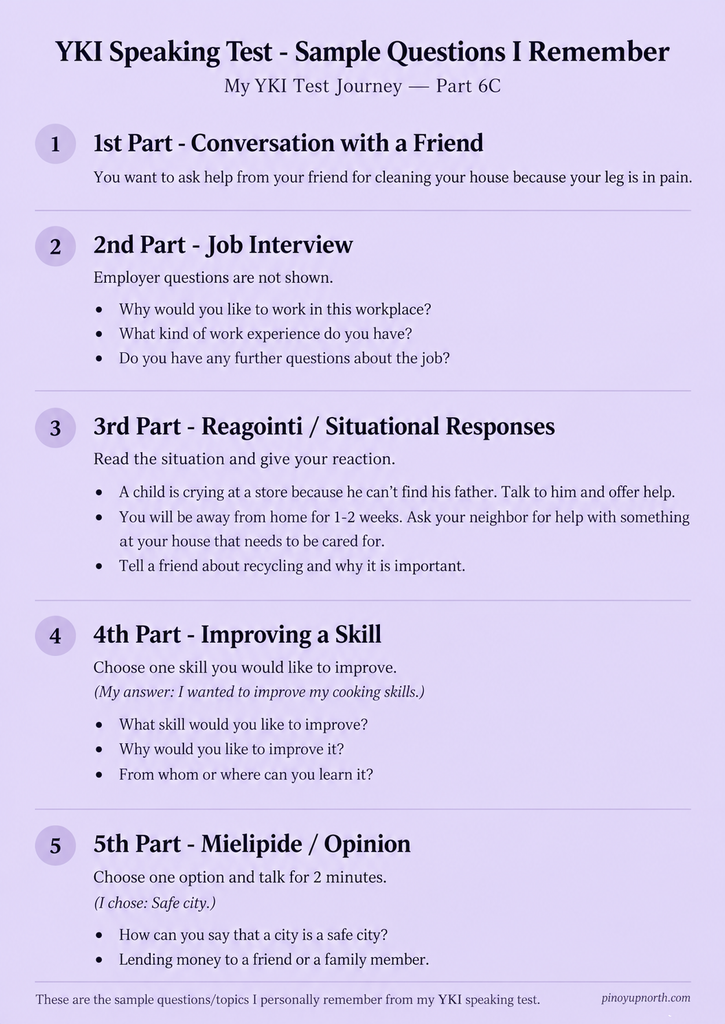
Note: These are questions and topics I personally remember from my own YKI examination in 2025. I may not remember the exact wording, and they should not be treated as official or guaranteed YKI test questions. Future tests may contain completely different topics.
My Biggest Lesson From the Speaking Test
The speaking section reinforced something I had already started learning through everyday life in Finland.
You do not need perfect Finnish to communicate.
Of course, grammar matters.
Vocabulary matters.
Pronunciation matters.
But communication also requires something else:
the willingness to actually speak.
Sometimes you will make mistakes.
Sometimes you will forget a word.
Sometimes you’ll realize halfway through your sentence that you used the wrong case ending.
Finish the sentence anyway.
Then try again.
That is part of learning.
Follow My YKI Test Journey
This article is part of my My YKI Test Journey series, where I share my personal experience preparing for and taking the Finnish YKI test.
Main Article – My YKI Test Journey
Part 6A – What Is the YKI Test?
Part 6B – How I Prepared for the YKI Test
Part 6C – YKI Speaking Test
Part 6D – YKI Writing Test
Part 6E – YKI Reading and Listening Test
Part 6F – What I Found Most Difficult About YKI
Part 6G – My YKI Test Results
Part 6H – 5 Things I Would Do Differently
You can also follow the Finnish-learning journey that came before YKI:
→ Learning Finnish: The Beginning of My Language Journey
→ My Finnish Language Journey Series
Final Thoughts
The YKI speaking test was challenging, but perhaps the biggest challenge wasn’t Finnish grammar itself.
It was learning to trust the Finnish I already knew.
There wasn’t enough time to search for perfect sentences.
I had to use the vocabulary I had.
Use the grammar I remembered.
Think quickly.
And speak.
Looking back, all those strange moments of talking to myself in front of a mirror, answering random pieces of paper, speaking Finnish at work, recording myself and practising under time pressure suddenly made sense.
They were preparing me for those few minutes inside the examination room.
And if I could give my earlier self one piece of advice before walking into that speaking test, it would simply be:
Don’t wait for perfect Finnish.
Listen. Focus. And speak anyway.
“Confidence doesn’t mean speaking without mistakes. Sometimes it simply means continuing even after you make one.”
“I will speak of thy testimonies also before kings, and will not be ashamed.”
- Psalm 119:46 (KJV)
Important: This post describes my personal experience taking the intermediate-level Finnish YKI test in 2025. Test arrangements, task formats and procedures may change, and individual test centers may have different physical setups. The Finnish National Agency for Education currently states that speaking and listening are usually completed in a language lab and advises candidates to read and listen carefully to instructions, use their normal speaking voice and attempt every task. Always check current official YKI information before your own examination.
Sources
- Finnish National Agency for Education – Before the YKI Test
Official guidance about the examination day and completing the speaking subtest. Opetushallitus - Finnish National Agency for Education – YKI Speaking Assessment Criteria
The official speaking criteria consider the overall performance, including fluency, coherence, expression, pronunciation and grammatical structures. Opetushallitus - University of Jyväskylä / Centre for Applied Language Studies – Finnish Intermediate-Level Speaking Examples
Official practice materials showing examples of YKI speaking task types, preparation periods and timed responses. Yleiset kielitutkinnot