My YKI Test Journey — Part 6E
If speaking required me to think quickly and writing required me to keep my hand moving, the reading and listening parts of YKI required something else entirely:
concentration.
A lot of it.
For me, these two subtests were challenging in different ways.
With reading – tekstin ymmärtäminen, I could see the text in front of me, go back to a paragraph, underline something, and read a sentence again.
With listening – puheen ymmärtäminen, things felt very different.
Once the speaker started talking, I had to listen carefully and understand as much as I could while the recording continued.
And sometimes?
I honestly had no idea what I had just heard. 😂
Of the four YKI subtests, listening was personally the most difficult one for me.
In this post, I’ll share what my reading and listening tests were like, the five biggest challenges I faced, and some lessons I learned during the examination.
Note: The timings and details I mention below describe my own intermediate-level Finnish YKI examinations in 2025. Test arrangements can change, so always check the latest official YKI information before your test.
My YKI Reading Test Experience
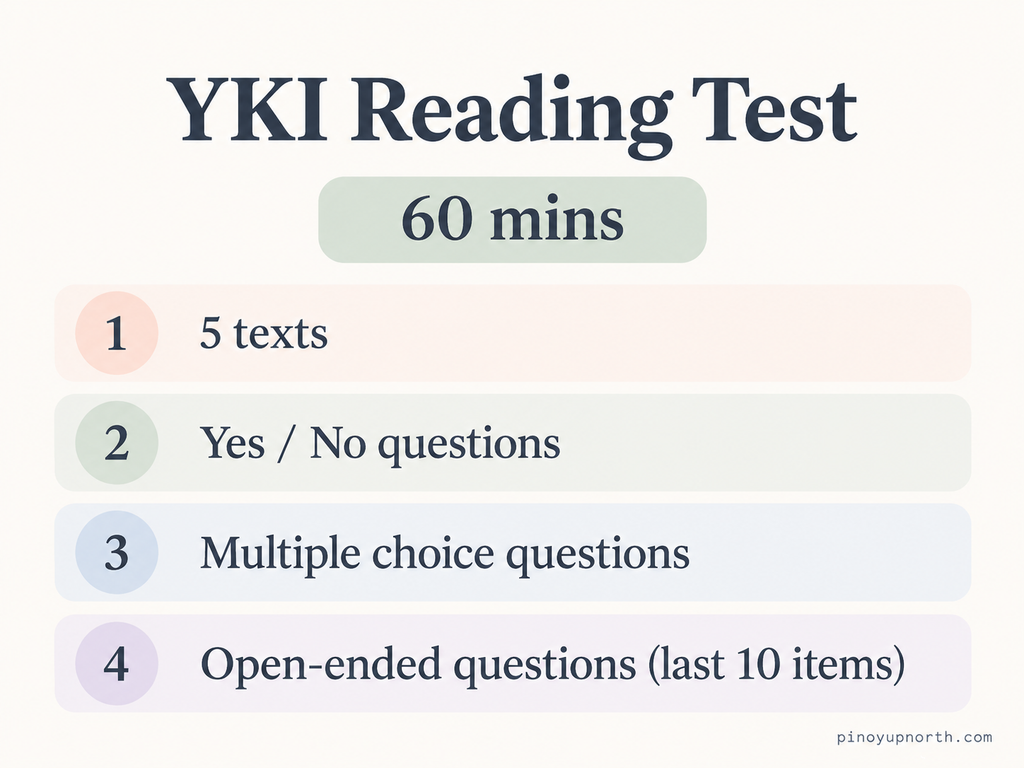
During my test, the reading section lasted around 60 minutes.
As I remember it, there were about five different texts, each followed by several questions.
The questions included:
- Yes / No or True / False questions
- Multiple-choice questions
- Open-ended questions
These question types are also included in the official YKI practice materials. The Finnish National Agency for Education lists multiple-choice, true/false and open-ended questions among the main YKI task types.
Source: Opetushallitus
For me, the most difficult were definitely the:
Open-ended questions.
With multiple choice, even if you’re unsure, you can at least look at the available answers.
A.
B.
C.
One of them is there somewhere. 😅
But with an open-ended question, you actually have to understand enough of the text and the question to formulate your own answer.
And that was where things became more challenging.

My YKI Listening Test Experience
Then came listening.
Oh, listening. 😂
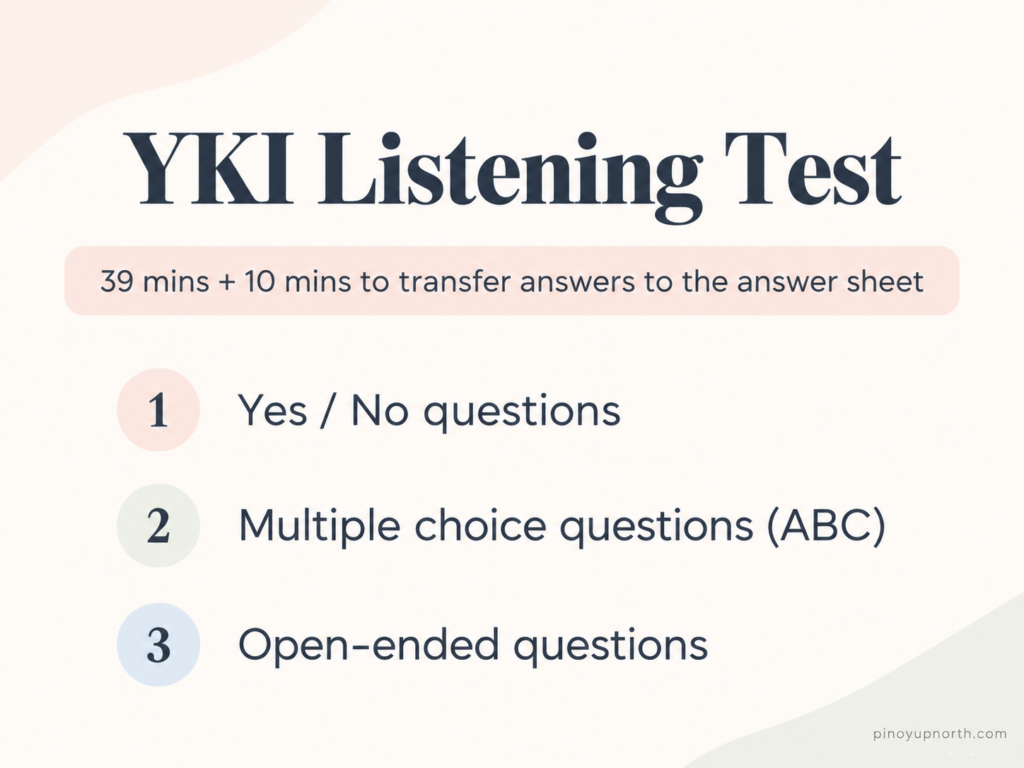
In my 2025 examination, I remember the listening section itself lasting around 39 minutes, followed by approximately 10 minutes to transfer the required answers to the separate answer sheet.
The question types were similar:
- Yes / No or True / False
- Multiple choice
- Open-ended questions
Official intermediate-level YKI practice materials likewise include multiple-choice, true/false and open-ended listening tasks.
Source: Yleiset kielitutkinnot
During the test, I listened through headphones.
Some information was available in the booklet, but there were also parts where paying close attention to the recording itself was essential.
And this was where I struggled the most.
If I didn’t understand what the speaker said…
and then I didn’t fully understand the question either…
well…
good luck to me. 😂
Still, I tried.
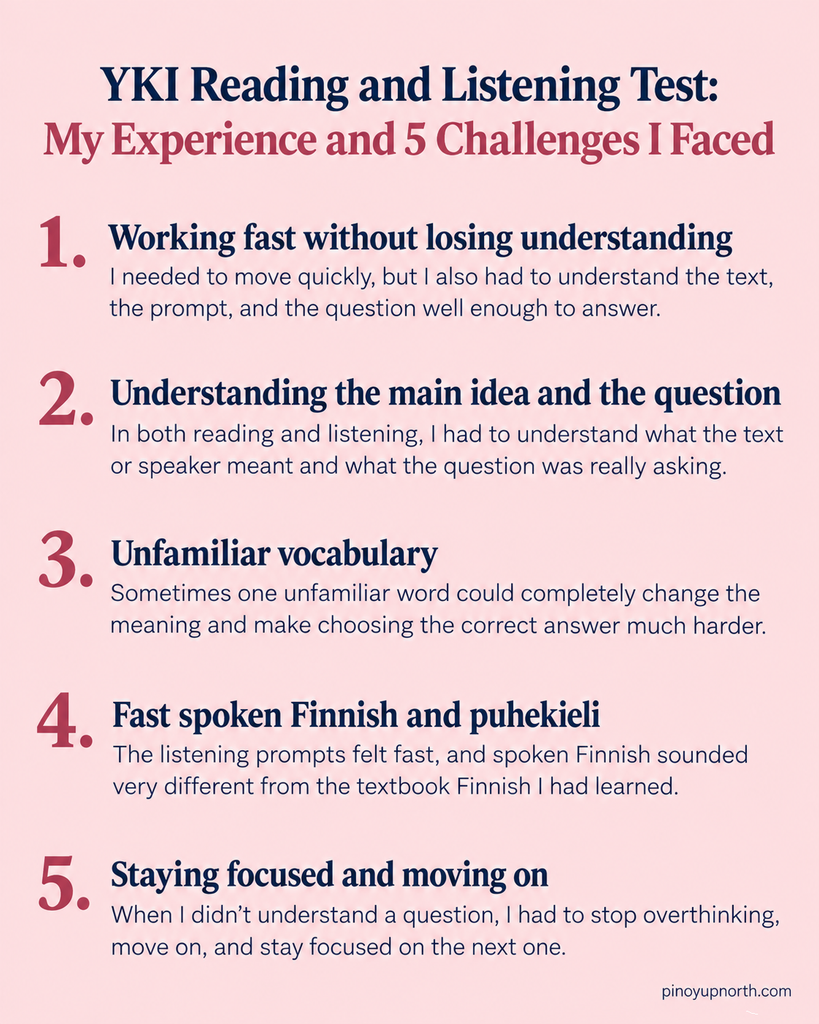
5 Challenges I Faced During the YKI Reading and Listening Tests
1. Working Fast Without Losing Understanding
Speed mattered a lot during reading.
Sixty minutes might sound like plenty of time until you see several texts and all the questions waiting underneath them.
I couldn’t spend forever trying to understand one paragraph.
There were moments when I realized:
Okay, Dii, you need to move faster.
At the same time, reading too quickly could also cause problems.
I needed to understand at least:
What is this text mainly about?
What exactly is the question asking?
Where in the text can I possibly find the answer?
So I tried to find a balance between speed and understanding.
Sometimes I read the question first before going back to the text.
That helped me know what information I was actually searching for instead of trying to perfectly translate every sentence.
And when I couldn’t understand everything?
I looked for the words I did recognize and tried to make sense of the message from there.
2. Understanding the Main Idea and the Question
This sounds obvious, but it became one of the biggest challenges in both tests.
You need to understand the question before you can answer it.
In reading, I might understand the general topic of the text but still become confused by what a particular question wanted.
In listening, I might understand several words from the recording but miss the main point.
That is different from truly understanding what was being communicated.
Official YKI practice materials show that reading questions can ask about specific details as well as what a text is communicating more generally, while listening tasks similarly require test takers to identify information from spoken material.
Source: Yleiset kielitutkinnot
So during the exam, I tried to ask myself:
What is the main idea?
Then:
What exactly are they asking me to find?
Those two questions helped me avoid getting lost in every unfamiliar word.
3. Unfamiliar Vocabulary – Especially That ONE Important Word
This one could be frustrating. 😂
Imagine understanding almost an entire sentence…
except for one word.
And somehow that one word changes everything.
Maybe the choices look almost identical.
Maybe one sentence says something happened.
Another says it didn’t happen.
Maybe the word is a synonym you don’t recognize.
Or perhaps it changes the whole meaning of the statement.
Suddenly, that one unfamiliar word becomes the most important word in the universe. 😂
This happened to me in both reading and listening.
During reading, I tried to look at the surrounding words for clues.
What is the paragraph generally talking about?
Is this word describing something positive or negative?
Does another sentence explain the same idea differently?
And for multiple-choice or true/false tasks, I became especially careful about small words that could completely change the meaning.
4. Fast Spoken Finnish and Puhekieli
And here comes my biggest challenge:
Listening to natural spoken Finnish.
Sometimes the speakers sounded so fast to me that I remember thinking:
Excuse me… am I taking an expert Finnish exam already? 😂
In my head I was saying:
Please speak slower. I’m still learning! 😅
But of course, the recording wasn’t going to slow down just because I asked nicely inside my mind.
So…
what to do?
Keep listening.
Spoken Finnish can also sound different from the Finnish we learn in books.
Words can shorten.
Sounds connect.
People speak naturally.
And when you’re still learning Finnish, a sentence that looks perfectly understandable on paper can suddenly feel completely different when somebody says it quickly.
This was another reason I wished I had spent even more time listening to natural Finnish before the exam.
Podcasts.
Conversations.
Television.
News.
Everyday puhekieli.
Not only slow Finnish created for learners.

5. Staying Focused – And Moving On
This may have been the most important lesson of both subtests.
You have to move on.
There were times when I didn’t know the answer.
Especially during listening.
And my brain wanted to stay there:
What did she say?
Was the answer A?
Maybe B?
Wait… what was that word?
Meanwhile…
the test had already moved to the next question. 😂
That’s dangerous.
If you keep thinking about the previous question, you might miss the next one too.
Then suddenly one difficult question becomes two.
Then three.
So I learned to tell myself:
It’s done. Move on.
Official YKI guidance also tells candidates to complete all tasks and always try to answer something.
Source: Opetushallitus
That became my strategy.
If I wasn’t sure, I made the best decision I could and continued.
There were still many more opportunities to answer correctly.
Hearing Other Test Takers Could Also Be Distracting
Just like during speaking, being aware of the other test takers could affect my concentration.
Sometimes I could sense someone beside me already writing an answer.
Meanwhile, my booklet was still empty.
And immediately my brain would start:
Oh no. They understood it. I didn’t.
That kind of thinking doesn’t help.
Their answer might even be wrong.
And more importantly:
their test performance has nothing to do with mine.
So I had to bring my attention back to:
the recording,
the text,
the question,
and my own answer.
Focus became incredibly important.

My Strategy for Reading Questions
One thing that helped me was marking or circling keywords.
I looked for important words in the question and tried to find related information in the text.
I also paid attention to:
synonyms
and
opposites or antonyms.
Sometimes the test doesn’t repeat the exact same word from the text in the answer choice.
The idea may be expressed differently.
That’s why simply hunting for one identical word isn’t always enough.
You still need to understand what the sentence means.
And sometimes, as I mentioned earlier, one small word can turn the entire meaning around.
So:
read carefully.

My Strategy for Listening Questions
Listening was harder for me because I couldn’t control the speaker.
I couldn’t say:
“Anteeksi, vielä kerran?” 😅
So before a recording began, whenever I had the opportunity, I tried to look at the questions or choices and identify keywords.
That gave my brain something specific to listen for.
Names.
Places.
Times.
Reasons.
Opinions.
Numbers.
Anything important.
Then once the recording began, I focused as much as possible.
And if I missed something?
Again:
move on.

Open-Ended Questions Were the Hardest for Me
For both reading and listening, I personally found open-ended questions the most difficult.
Why?
Because I couldn’t depend on choices.
I needed to understand the information and produce an answer myself.
Official example materials for both intermediate-level reading and listening include this type of task alongside multiple-choice and true/false questions.
Source: Yleiset kielitutkinnot
For me, the most important thing was to answer the actual question rather than trying to write something complicated.
If I understood a simple answer, I wrote the simple answer.
This was not the time to show off every difficult Finnish word I had memorized.
I just wanted to demonstrate that I understood the information.
I Really Thought I Had Failed Listening
I’m not sharing this to discourage anyone preparing for YKI.
Quite the opposite.
I’m sharing it because this was genuinely how I felt.
When the listening test finished, I thought:
That’s it. I probably failed that part.
There were too many moments when I felt uncertain.
Too many words I hadn’t understood.
Too many answers I wasn’t completely confident about.
But much later, when I received my results…
I discovered that I had passed the listening part after all.
But this taught me something important:
How you feel immediately after an exam is not necessarily how you actually performed.
So don’t decide that you’ve failed while you’re still sitting in the examination room.
Keep going.
What I Would Do Differently
If I were preparing for YKI again, listening would receive much more of my attention.
I would listen to more Finnish at normal speed.
I would practise understanding the main idea without trying to translate every word.
I would expose myself to more puhekieli.
And I would practise letting unknown words go instead of getting stuck on them.
For reading, I would continue practising under a time limit.
Because knowing Finnish is only part of the challenge.
You also need to use what you know within the time you’re given.
My Biggest Lessons From Reading and Listening
If I could summarize what helped me during these two subtests, it would be:
FOCUS.
Find the keywords.
Look for the main idea.
Watch out for synonyms and opposite meanings.
Don’t panic because of one unfamiliar word.
Answer what you can.
And most importantly:
MOVE ON.
One difficult question does not mean you’ve failed the whole test.
One recording you couldn’t understand does not mean you won’t understand the next one.
Stay positive.
There are still more questions ahead.
And who knows?
You may have done much better than you think.
I certainly did. 😅
Reading and Listening Test Format I Remember
I couldn’t remember all the individual texts and questions from my examination because there were simply too many.
But this is the general structure I remember from my 2025 YKI test:
Reading – approximately 60 minutes
Listening – approximately 39 minutes + answer-transfer time
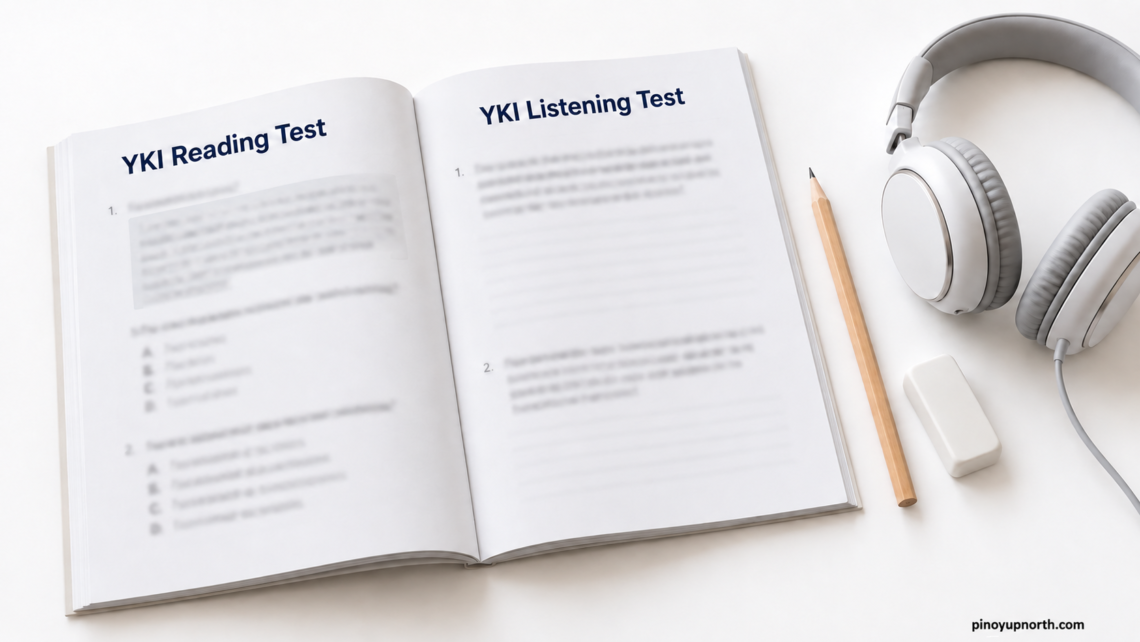
I have also prepared a Reading and Listening PDF based on what I personally remember from my test, which readers can use together with this post.
Follow My YKI Test Journey
This article is part of my My YKI Test Journey series, where I share my personal experience preparing for and taking the Finnish YKI test.
Main Article – My YKI Test Journey
Part 6A – What Is the YKI Test?
Part 6B – How I Prepared for the YKI Test
Part 6C – YKI Speaking Test
Part 6D – YKI Writing Test
Part 6E – YKI Reading and Listening Test
Part 6F – What I Found Most Difficult About YKI
Part 6G – My YKI Test Results
Part 6H – 5 Things I Would Do Differently
You can also follow the Finnish-learning journey that came before YKI:
→ Learning Finnish: The Beginning of My Language Journey
→ My Finnish Language Journey Series
Final Thoughts
Reading and listening challenged me in completely different ways.
Reading tested my patience, vocabulary, comprehension and ability to work quickly.
Listening tested all of those things…
except the Finnish kept moving while I was trying to understand it. 😂
There were moments when I felt confident.
There were moments when I guessed.
And there were definitely moments when I wondered whether I understood Finnish at all.
But I kept answering.
That may be one of the biggest lessons YKI taught me.
You don’t need to feel confident about every question.
You don’t need to understand every single word.
Sometimes you just need to gather what you do understand, make the best answer you can, and continue.
Don’t let one difficult question convince you that the whole examination is already lost.
There might be another question waiting for you that you understand perfectly.
Keep going.
Keep listening.
Keep reading.
And most importantly…
don’t give up before the results even arrive.
“One question you couldn’t understand does not define the whole exam. Move forward and give the next one your best.”
“The heart of the prudent getteth knowledge; and the ear of the wise seeketh knowledge.”
- Proverbs 18:15 (KJV)
Important: This post describes my personal experience with the intermediate-level Finnish YKI examination in 2025. My remembered timings, number of texts and test-day experiences should not be treated as a guarantee of what another YKI examination will contain. Current official YKI guidance confirms that the main task types include multiple-choice, true/false and open-ended questions, and candidates are encouraged to complete all tasks and try to answer every question. Opetushallitus. Always check the latest official information before taking your own examination.
Sources
- Finnish National Agency for Education – Before the YKI Test
Official information about test-day arrangements, task types and instructions for candidates. Opetushallitus - University of Jyväskylä / Centre for Applied Language Studies – Intermediate-Level Reading Comprehension
Official practice examples for multiple-choice, true/false and open-ended reading tasks. Yleiset kielitutkinnot - University of Jyväskylä / Centre for Applied Language Studies – Intermediate-Level Listening Comprehension
Official examples of the main intermediate-level listening task types.