My YKI Test Journey — Part 6D
One thing I remember very clearly about the YKI writing test?
My hand hurt afterward. 😅
After writing continuously under time pressure, I could definitely feel it.
Even though the writing part was challenging, I personally found it the easiest of the four YKI subtests.
Why?
Because unlike speaking or listening, I had a little more control.
I could stop for a moment.
Think.
Write down an idea.
Change the way I wanted to explain something.
And most importantly, I could manage my own time.
When I took my intermediate-level Finnish YKI test in 2025, I remember having around 55 minutes for the writing section. That became a little race between my thoughts, my pencil, and the clock. 😅
Official intermediate-level YKI practice materials show that the writing subtest includes three different writing tasks, and candidates are expected to complete all of them, follow the task instructions carefully, and write clearly.
Source: Yleiset kielitutkinnot
This is how I approached the writing test – including the six challenges I personally encountered along the way.
What the YKI Writing Test Was Like for Me
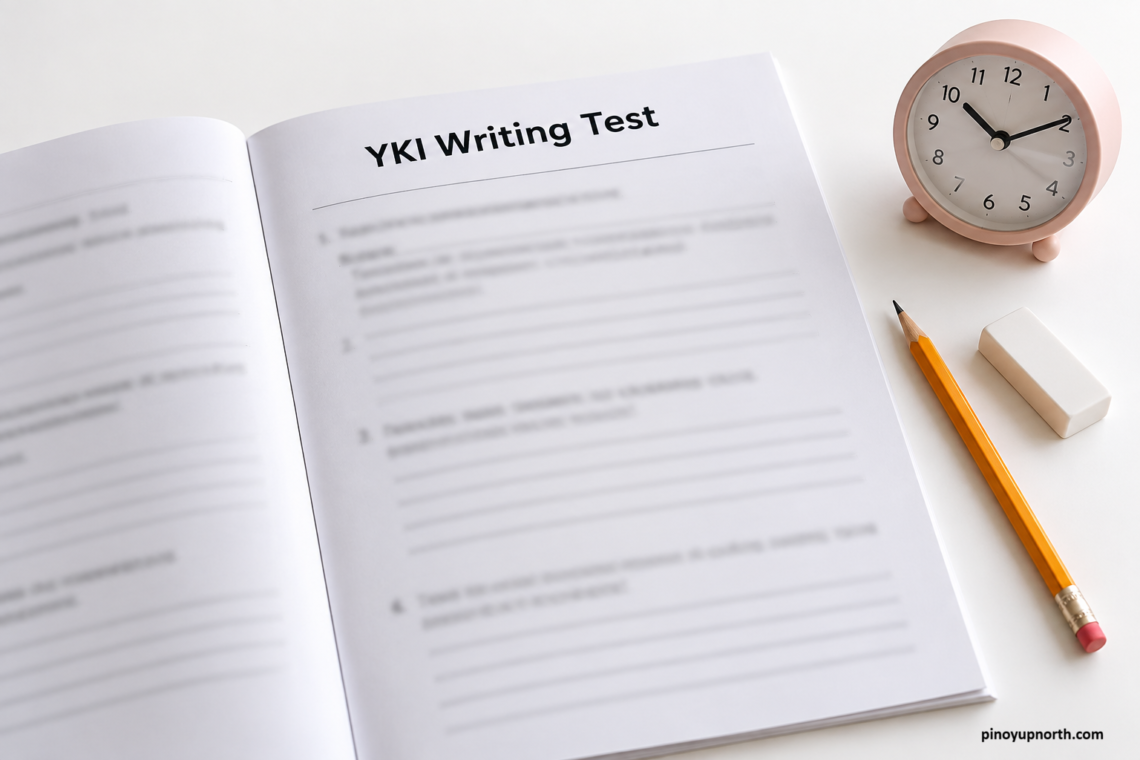
For the writing section, we were given a booklet containing the tasks and the spaces where we could write our answers.
The official YKI instructions state that the writing and reading comprehension subtests are completed in a classroom, while speaking and listening are usually done in a language lab.
Source: Opetushallitus
In my test, the first writing task was the shortest.
The second required a little more detail.
And the last task felt almost like writing a small essay or opinion piece.
This was also similar to many of the exercises I had been practising at home.
So when I saw the structure, it didn’t feel completely unfamiliar.
How I Divided My Time
Because I knew I had limited time, I tried to budget it before I started.
My rough plan was:
about 10 minutes for the first task,
15 minutes for the second,
and around 30 minutes for the final task.
This was only my personal strategy.
I knew the final writing task would require more thinking, explaining and organizing, so I wanted to save the biggest portion of my time for it.
Did I follow that schedule perfectly?
Not always. 😅
But having a plan stopped me from spending too much time trying to perfect one short answer and then panicking when I reached the last task.
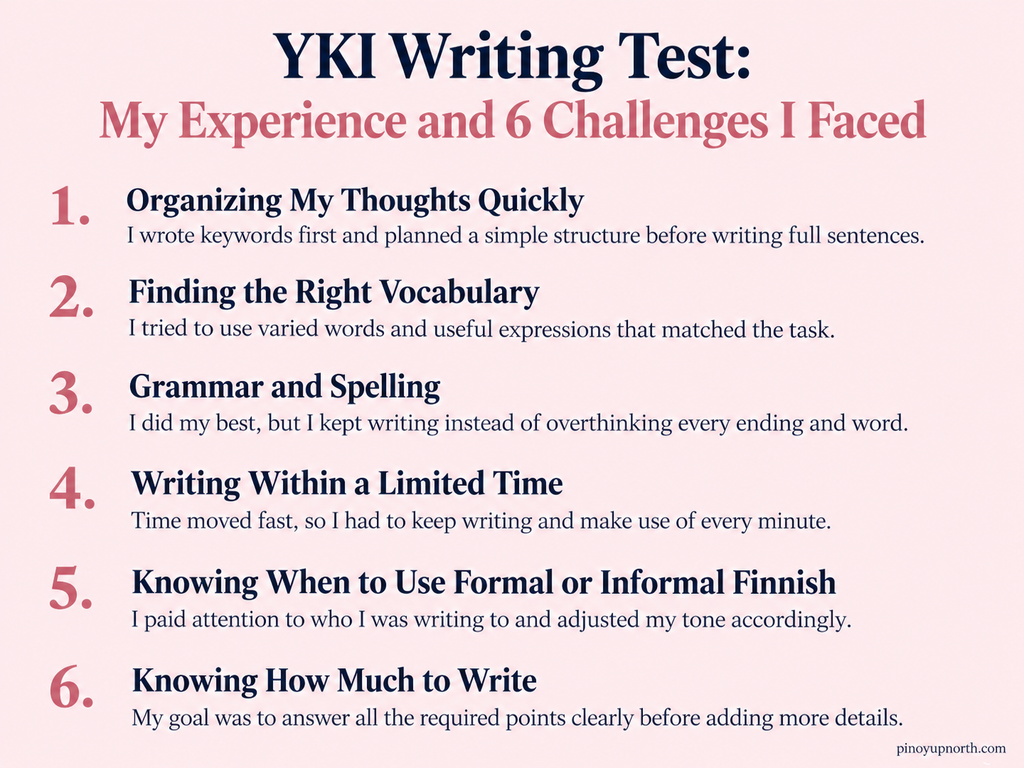
6 Challenges I Faced During the YKI Writing Test
1. Organizing My Thoughts Quickly
Before writing, I tried not to immediately start creating complete sentences.
Instead, I wrote a few keywords first.
What is the question asking?
What are the important points I need to include?
What examples can I give?
Then I thought about how I wanted to arrange them.
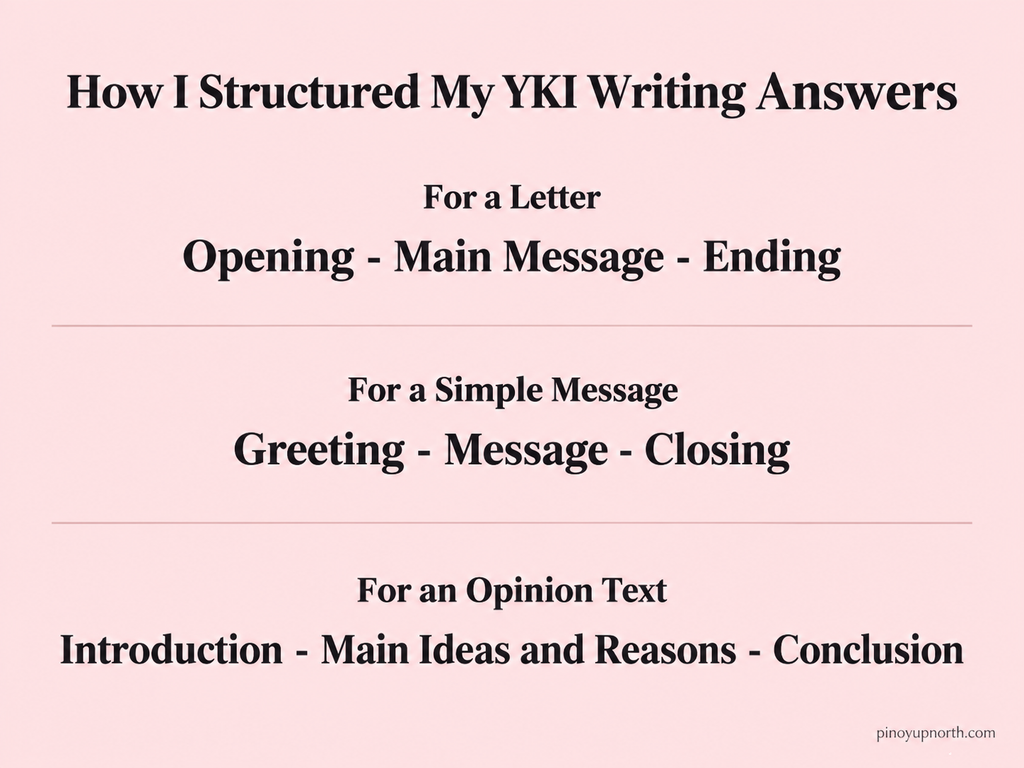
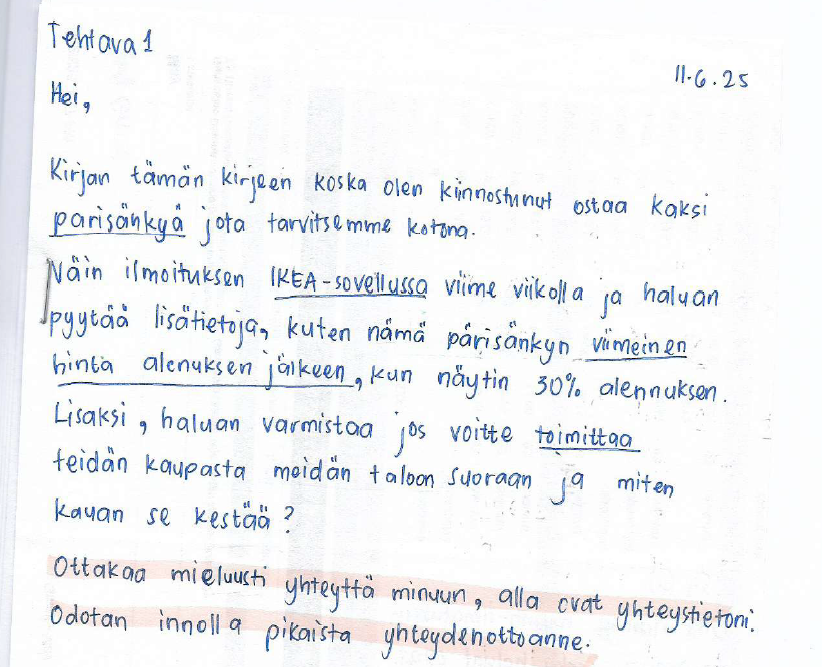
For a letter, I usually thought of:
opening – main message – ending
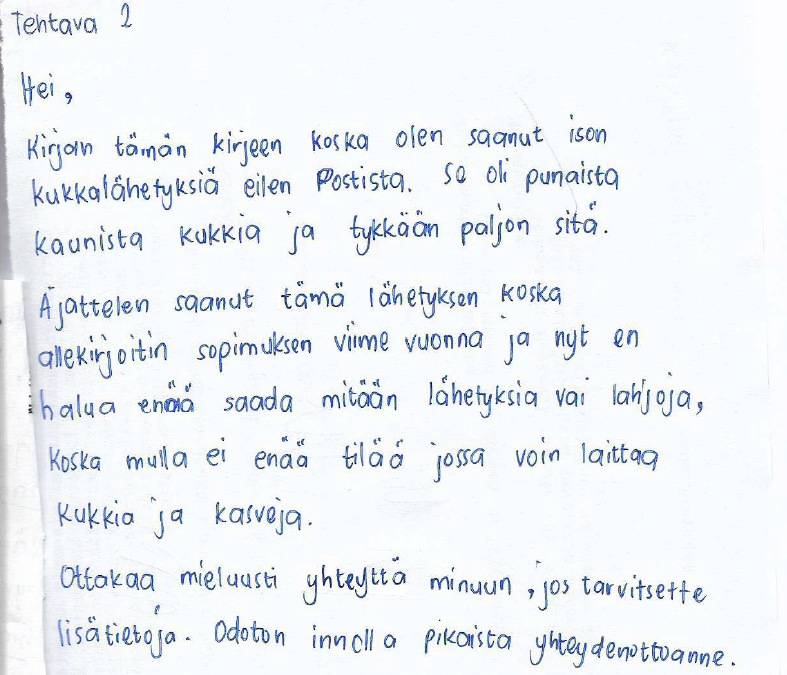
For a simple message:
greeting – message – closing
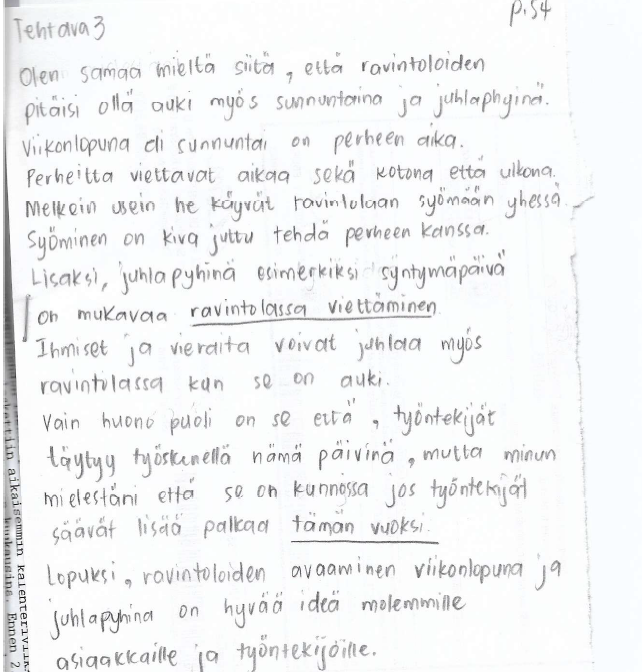
And for something more like an opinion text:
introduction – main ideas and reasons – conclusion
This made writing easier because I wasn’t inventing the whole answer sentence by sentence without knowing where I was going.
I had at least a small map inside my head.
Official intermediate-level example tasks also show that writing prompts may ask you to include several specific points and, depending on the task, use an appropriate beginning and ending.
Source: Yleiset kielitutkinnot
2. Finding the Right Vocabulary
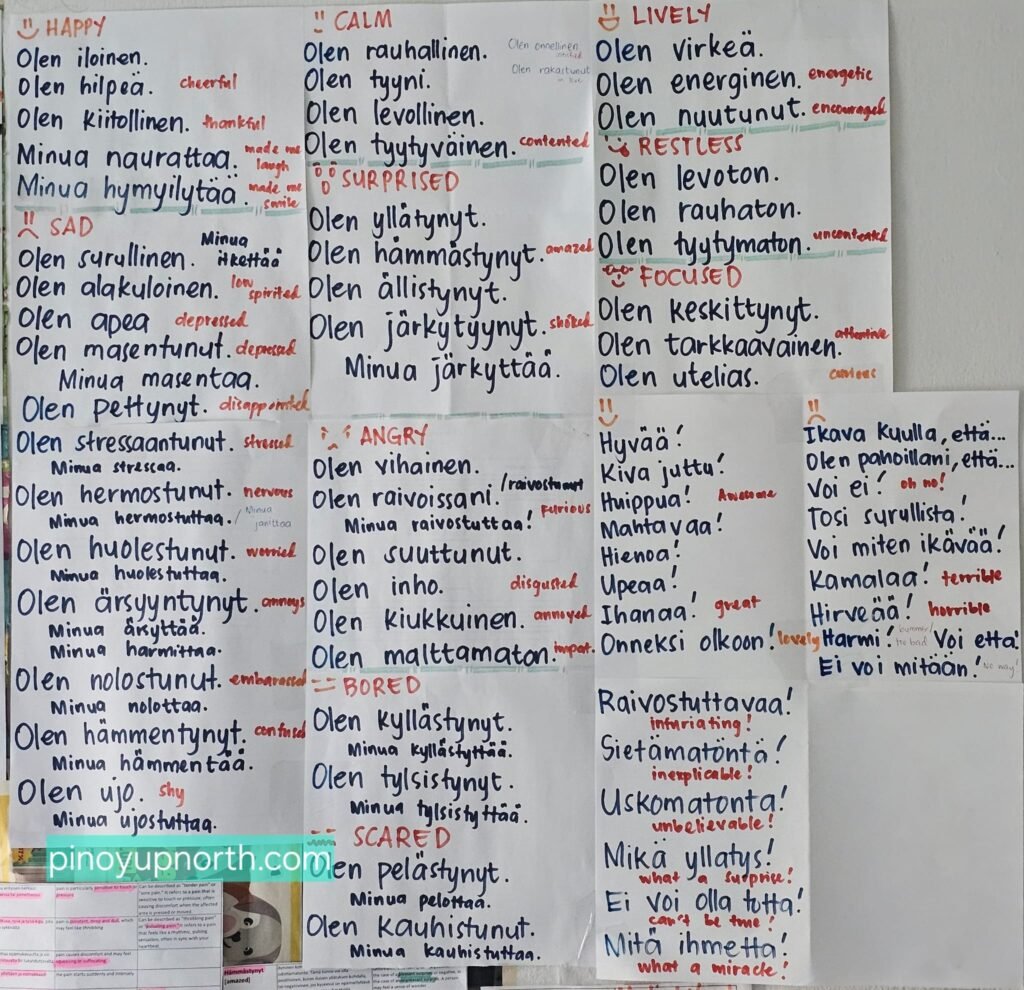
This was where all those vocabulary lists I had memorized became useful.
I tried to use words and expressions that were a little more varied instead of repeating the same simple words again and again.
I also tried using some useful phrases and expressions I had practiced.
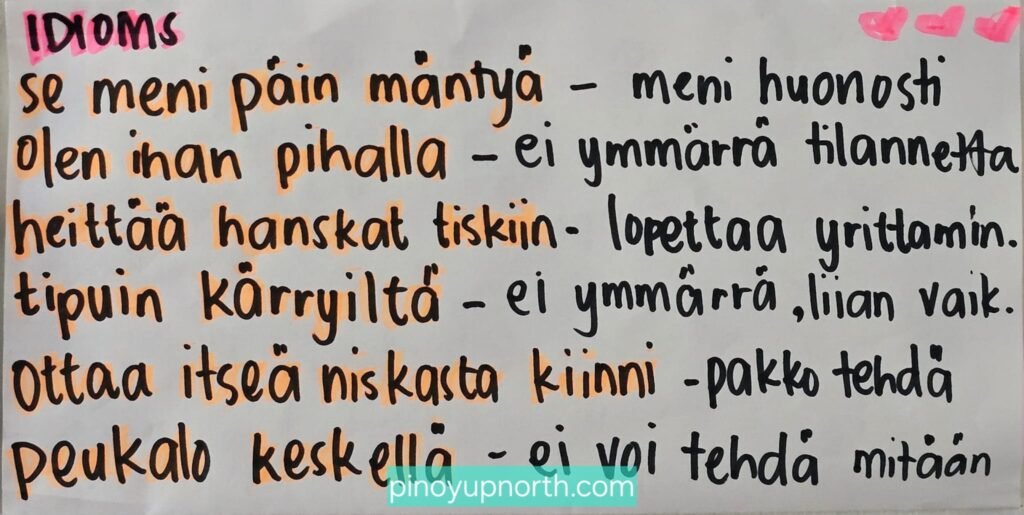
Sometimes I even added an idiom – but only when I was confident that it actually made sense in the context.
There is no point adding a beautiful Finnish expression if it has absolutely nothing to do with what you’re writing. 😅
One thing I learned while preparing for YKI was that memorizing vocabulary was helpful, but actually using it was what made it stay in my memory.
3. Grammar and Spelling
Finnish grammar can make writing very slow if you question every single ending.
Was that partitive?
Genitive?
Illative?
Should there be two consonants?
One?
Did I spell that word correctly?
If I stopped for several minutes every time I wasn’t sure, I would never finish.
So during the examination, I tried to do my best with grammar and spelling while also remembering that I had limited time.
If I knew how to correct something quickly, I corrected it.
If I was unsure but the sentence was understandable, I continued.
That does not mean grammar and spelling are unimportant.
They matter.
But for me, trying to create a completely flawless sentence sometimes became the enemy of actually finishing the task.
4. Writing Within a Limited Time
This was one of the biggest challenges.
Those 55 minutes disappeared very quickly.
Five minutes might not sound like much when you’re at home.
Inside an examination room?
Five minutes is precious.
I tried to remind myself:
This isn’t the time to stare at the wall waiting for the perfect sentence.
Write something.
Develop it.
Continue.
Of course, there were moments when I needed to stop for a few seconds because my hand was getting tired.
But I tried to use almost every available minute.
The Finnish National Agency for Education specifically advises YKI candidates to complete all tasks and always try to answer something.
Source: Opetushallitus
That became my approach too.
5. Knowing When to Use Formal or Informal Finnish
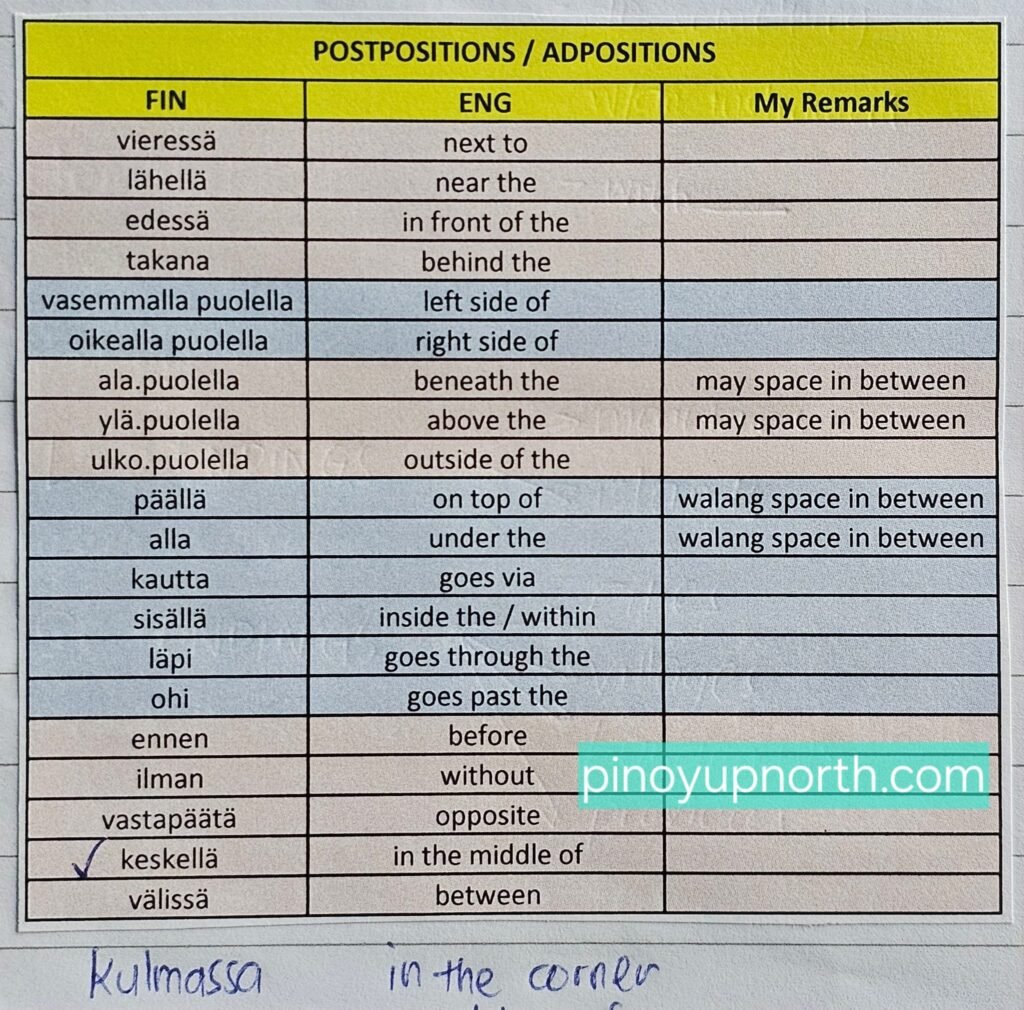
Another thing I paid attention to was who I was writing to.
The language you use when writing to an employer or an official should not necessarily sound exactly the same as a casual message to your friend.
For example, I would normally use a more formal style when writing to:
an employer,
a teacher or professor,
a company,
or a local authority.
On the other hand, a message to a friend, neighbor or someone you know personally can sound more relaxed.
This was something I had practised many times in my reviewers.
The official intermediate-level practice tasks also include different text types, such as an email to a housing manager and an opinion text, which means understanding the situation and intended reader is important when responding.
Source: Yleiset kielitutkinnot
6. Knowing How Much to Write
This was something I thought about a lot while practising.
During my own examination, I focused less on counting words and more on making sure I had actually answered what was being asked.
Personally, I tried to use most of the answer space available to me.
But I don’t think writing more simply for the sake of writing more is the goal.
A longer answer that ignores half of the task isn’t necessarily better than a shorter response that clearly addresses what was asked.
So my personal approach was:
Answer every required point first.
Then, if I still had time and space, I added explanations, examples or supporting details.
In my test, I didn’t need an extra answer sheet.
And honestly, I preferred keeping everything within the original answer area because I didn’t want to add unnecessary sentences that might create even more opportunities for mistakes.
The Opinion Task Was the Longest for Me
The final writing task felt like the biggest one.
This was where I really tried to explain my thoughts.
For an opinion-style answer, I usually followed a simple structure.
First, I introduced what I thought about the topic.
Then I gave reasons.
After that, I tried to explain those reasons with examples.
Finally, I ended with a short conclusion.
This was probably the task where I wrote the most.
Sometimes when you’re writing an opinion, you suddenly realize you have plenty to say.
Then the challenge becomes:
How do I say all of this in Finnish? 😂
My Writing Practice Before YKI
My writing preparation did not happen only during formal study sessions.
I practised using several sources.
I answered exercises from books.
I completed online YKI practice activities.
I wrote sample letters, messages and opinion texts.
My work in healthcare also gave me opportunities to practise written Finnish through documentation and reports.
And, of course, I made plenty of mistakes.
Looking back at some of my old practice answers now is actually interesting.
The grammar wasn’t perfect.
The spelling wasn’t perfect.
But I can see the progress.
And that’s exactly why I kept those reviewers.
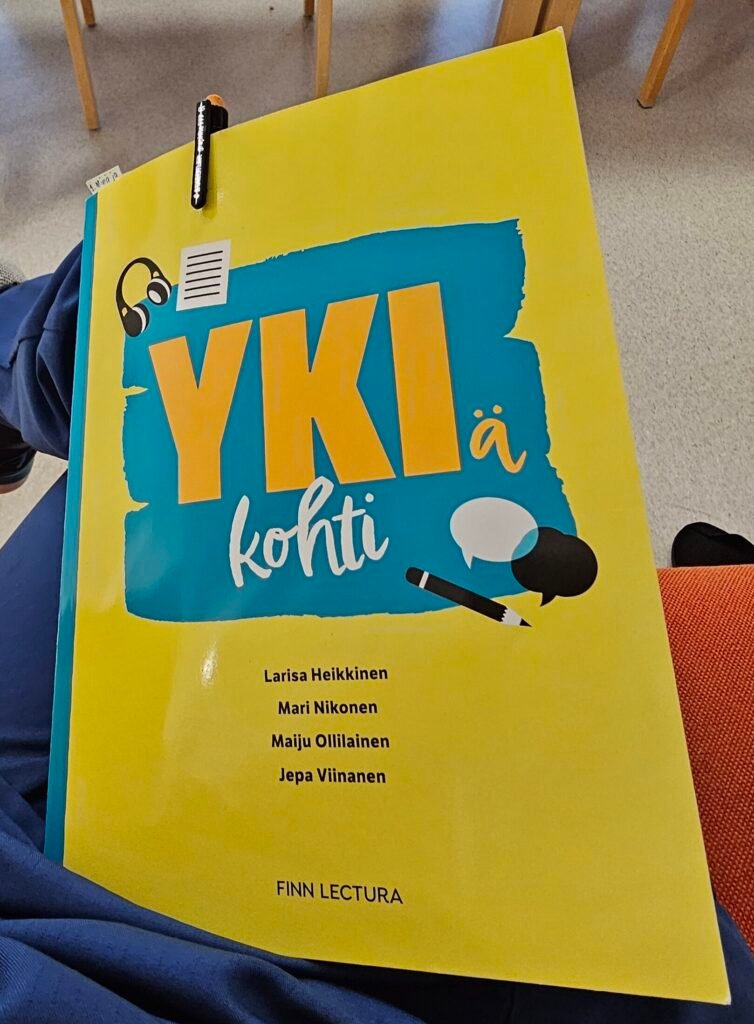
My Hands Really Did Get Tired
This might sound like a small thing, but when you spend almost an hour writing by hand while concentrating intensely, your hand can genuinely get tired.
We type so much nowadays that writing several pages by hand feels different.
During preparation, I think practising handwritten answers helped me too.
It wasn’t only Finnish-language practice.
It also reminded my hand:
We’re going to be writing for a while. Get ready. 😂
Questions I Remember From My YKI Writing Test
I’ll also be sharing some of the writing topics and tasks that I personally remember encountering during my Finnish YKI test in 2025.
Note: These are writing topics and tasks I personally remember from my own YKI examination in 2025. I may not remember the exact wording, and they should not be considered official or guaranteed YKI questions. Future examinations may contain completely different tasks.
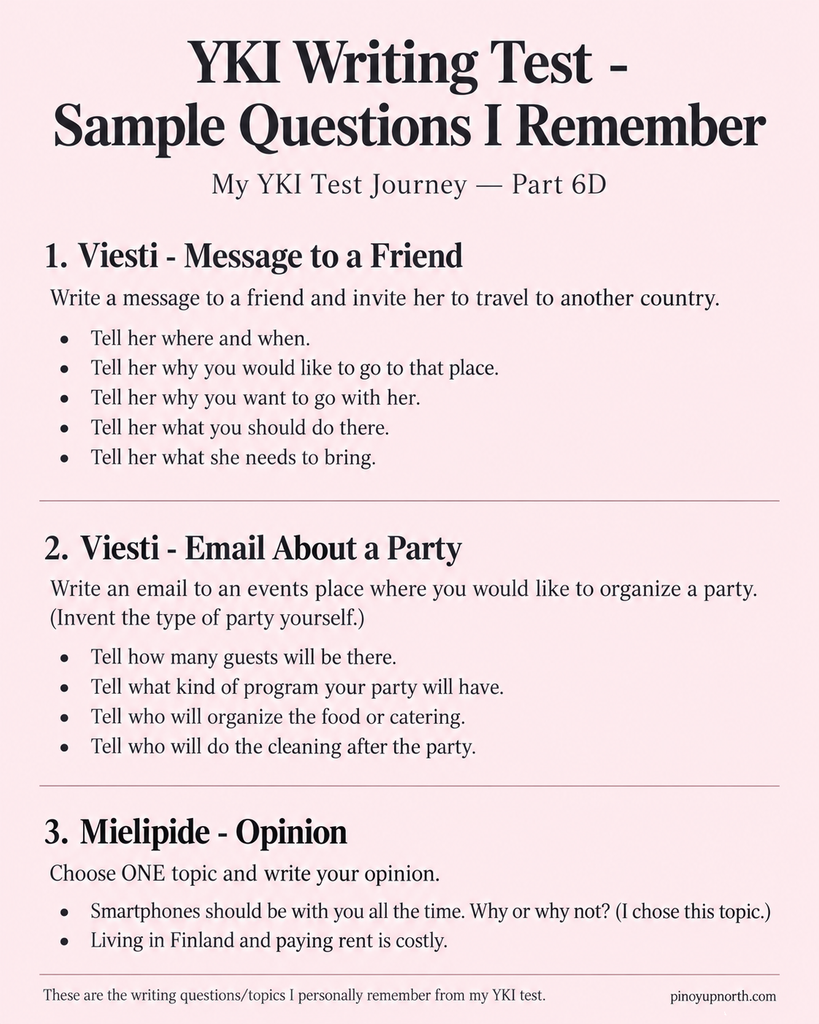
Official YKI preparation pages also make clear that publicly available practice exercises are examples and not official future test questions.
Source: Opetushallitus
What Helped Me Most
For me, the writing test came down to four things:
planning, vocabulary, time management and actually answering the question.
Beautiful grammar would not help me if I ran out of time before completing the task.
Fancy vocabulary wouldn’t help if it didn’t fit the sentence.
Writing an entire page wouldn’t help if I forgot to answer what the prompt actually asked.
So I tried to keep reminding myself:
Read carefully. Plan quickly. Write clearly. Finish the task.

Follow My YKI Test Journey
This article is part of my My YKI Test Journey series, where I share my personal experience preparing for and taking the Finnish YKI test.
Main Article – My YKI Test Journey
Part 6A – What Is the YKI Test?
Part 6B – How I Prepared for the YKI Test
Part 6C – YKI Speaking Test
Part 6D – YKI Writing Test
Part 6E – YKI Reading and Listening Test
Part 6F – What I Found Most Difficult About YKI
Part 6G – My YKI Test Results
Part 6H – 5 Things I Would Do Differently
You can also follow the Finnish-learning journey that came before YKI:
→ Learning Finnish: The Beginning of My Language Journey
→ My Finnish Language Journey Series
Final Thoughts
Among the four YKI subtests, writing was the one where I felt I had the most control.
I could think.
Plan.
Erase something.
Change a word.
And organize my answer before moving forward.
But that didn’t make it easy.
The clock was always there.
Grammar was always there.
That Finnish word I had memorized a hundred times but suddenly couldn’t remember?
Also there. 😅
What helped me was accepting that I wasn’t there to produce a perfect piece of Finnish writing.
I was there to show what I could do with the Finnish I had learned.
So I wrote.
I made mistakes.
I kept going.
And when the time was over, I put my pencil down knowing I had given every task my best attempt.
Sometimes that is all we can ask from ourselves.
“Don’t let the search for the perfect sentence stop you from writing the next one.”
“Whatsoever thy hand findeth to do, do it with thy might.”
- Ecclesiastes 9:10 (KJV)
Important: This post describes my personal experience with the intermediate-level Finnish YKI writing test in 2025. Test formats, timing, procedures and arrangements may change. Current official YKI information states that the intermediate writing subtest contains different writing tasks, and candidates should complete all tasks, write clearly and follow the instructions carefully. Always check the latest guidance before your own test.
Sources
- Finnish National Agency for Education – Before the YKI Test
Official information about YKI test-day arrangements and instructions. Opetushallitus - University of Jyväskylä / Centre for Applied Language Studies – Intermediate-Level Finnish Writing
Official example materials showing the types of writing tasks used at intermediate level. Yleiset kielitutkinnot - Finnish National Agency for Education – After the YKI Test
Information about YKI assessment and how trained assessors use official assessment criteria.