My YKI Test Journey – Part 6A
When I first started hearing about the YKI test, I knew it was connected to proving your Finnish language skills, but I did not fully understand how the examination worked.
What exactly does YKI measure?
What are the different levels?
And what do grades 1, 2, 3, 4, 5 and 6 actually mean?
Since YKI became an important part of my own Finnish language and nursing journey, I thought I would start this mini-series with a simple explanation for anyone who is hearing about the test for the first time.
If you are preparing for YKI yourself, hopefully this gives you a good place to start.
What Does YKI Mean?
YKI comes from the Finnish term yleiset kielitutkinnot, or the National Certificates of Language Proficiency.
It is an official language test for adults in Finland. Rather than testing only grammar or vocabulary, YKI measures how well you can actually use and understand a language in everyday situations.
Although my own YKI journey is about Finnish, YKI examinations are also available in several other languages.
What Does the YKI Test Measure?
The YKI test has four language skill areas:
- Listening comprehension (Puheen ymmärtäminen)
- Speaking (Puhuminen)
- Reading comprehension (Tekstin ymmärtäminen)
- Writing (Kirjoittaminen)
You receive a separate proficiency assessment for each subtest.
For me, I like to think of it simply like this:
Can I understand what I hear?
Can I speak and communicate?
Can I understand what I read?
Can I express myself in writing?
That is basically what the four parts are trying to measure.
What Are the YKI Levels?
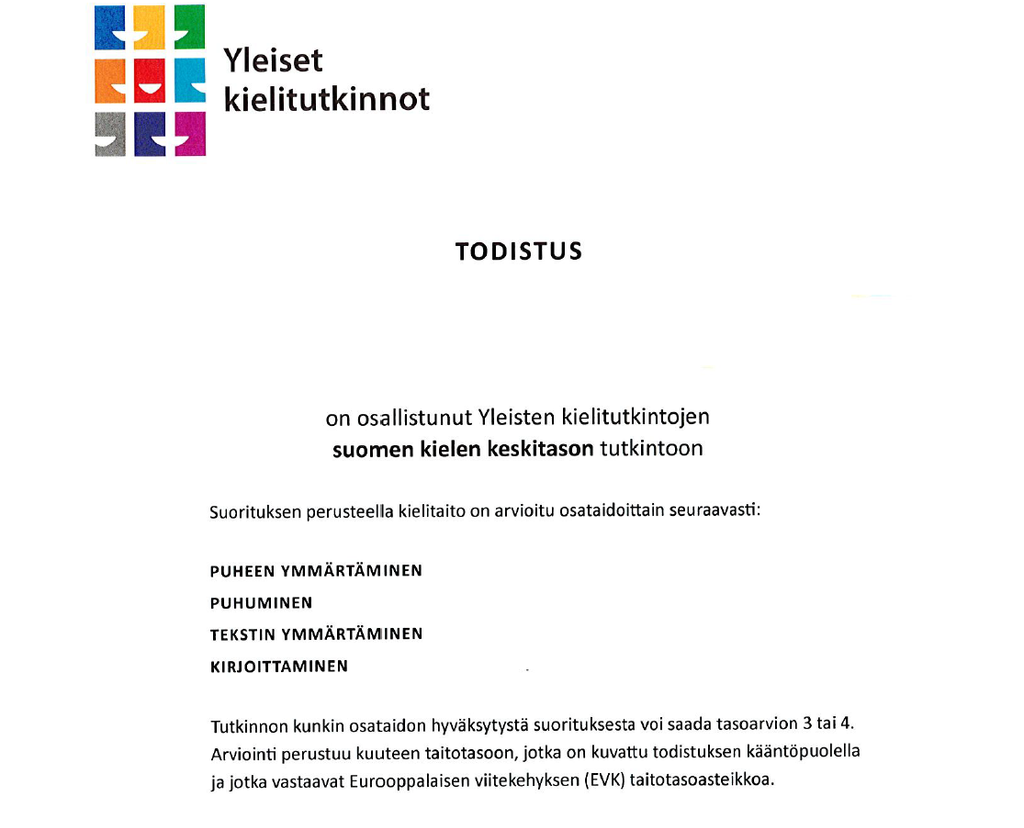
There are three YKI test levels: basic, intermediate and advanced.
| YKI Level | YKI Grade | CEFR Level | Current Full Test Fee |
|---|---|---|---|
| Basic (Perustaso) | 1 | A1 | €165 |
| Basic (Perustaso) | 2 | A2 | €165 |
| Intermediate (Keskitaso) | 3 | B1 | €190 |
| Intermediate (Keskitaso) | 4 | B2 | €190 |
| Advanced (Ylin taso) | 5 | C1 | €216 |
| Advanced (Ylin taso) | 6 | C2 | €216 |
The YKI grading scale corresponds with the familiar A1-C2 CEFR language levels. For example, YKI grade 3 corresponds to B1, while grade 4 corresponds to B2.
The current full-test fees are €165 for the basic level, €190 for the intermediate level and €216 for the advanced level. Certain people may qualify to take an advanced Finnish or Swedish YKI test free of charge, so it is always worth checking the current rules before registering.
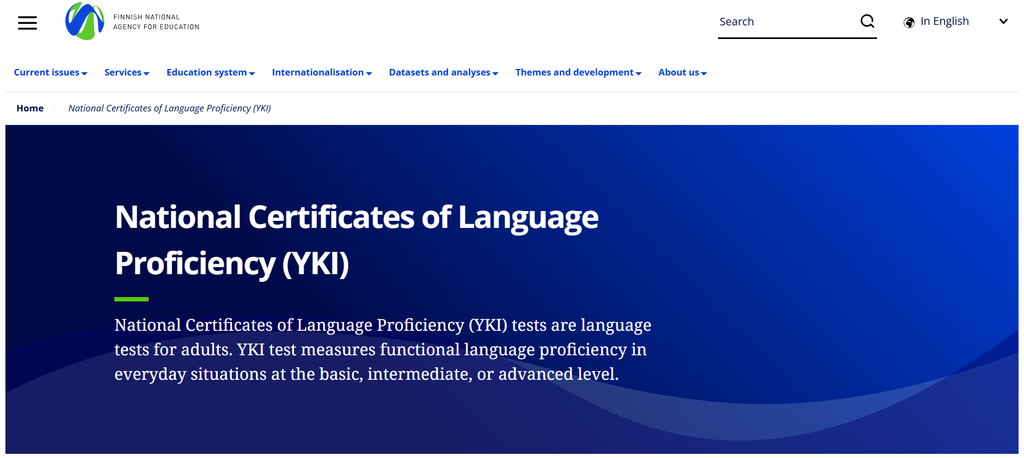
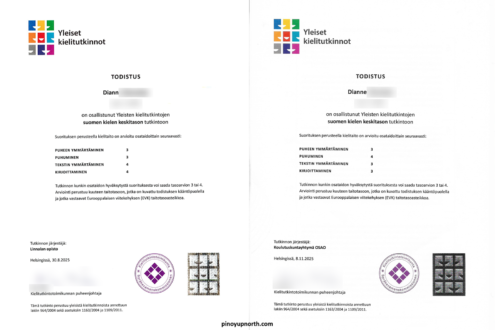
Image Source: Opetushallitus.fi
Which Level Did I Take?
For my own nursing pathway, I took the intermediate-level Finnish YKI test.
That meant my results could be assessed at either:
Grade 3 – B1
or
Grade 4 – B2
I will talk much more about my own required language level, preparation, examinations and results in the other parts of this series.
And yes…
I took the test twice. 😅
You can read the beginning of that story in my main article:
→ My YKI Test Journey: Taking the Finnish Language Test in Finland
Why Do People Take the YKI Test?
There are different reasons why someone may need an official YKI certificate.
According to the Finnish National Agency for Education, a YKI certificate can be used to demonstrate language proficiency when applying for things such as a job or study place, when an employer requires proof of language skills, or for certain official purposes such as Finnish citizenship or a permanent residence permit.
The exact language level required depends on why you need the certificate.
For example, when YKI is used to demonstrate Finnish or Swedish skills for a Finnish citizenship application, the official requirements specify particular combinations of subtests at grade 3 or higher.
So before registering, always check what your employer, school, authority or other organization specifically requires.
Do You Take All Four Tests on the Same Day?
Traditionally, a regular YKI examination includes all four subtests on the same test day.
However, there have been changes in 2026. Certain Finnish and Swedish intermediate-level YKI test days now allow participants to register for only selected subtests.
This is one reason why checking the latest official information is very important.
When I took my YKI tests in 2025, I completed the four subtests as part of my examination day.
And believe me…
it was a long day. 😅
Is YKI Only About Perfect Finnish?
This was something I also wondered about before taking the test.
YKI is designed to assess your ability to use and understand the language, not simply whether you have memorized every grammar rule.
The official preparation guidance explains that the test looks at how well you can understand, speak, read and write the language in test situations based on everyday themes.
That does not mean grammar and vocabulary are unimportant.
Of course they matter.
But one of the biggest things I learned during my own preparation was this:
You need to use the language.
And sometimes that means speaking even when you are not 100% sure that every word coming out of your mouth is perfect.

Follow My YKI Test Journey
This article is part of my My YKI Test Journey series, where I share my personal experience preparing for and taking the Finnish YKI test.
Main Article – My YKI Test Journey
Part 6A – What Is the YKI Test?
Part 6B – How I Prepared for the YKI Test
Part 6C – YKI Speaking Test
Part 6D – YKI Writing Test
Part 6E – YKI Reading and Listening Test
Part 6F – What I Found Most Difficult About YKI
Part 6G – My YKI Test Results
Part 6H – 5 Things I Would Do Differently
You can also follow the Finnish-learning journey that came before YKI:
→ Learning Finnish: The Beginning of My Language Journey
→ My Finnish Language Journey Series
Final Thoughts
Before taking YKI myself, the examination sounded a little intimidating.
Different levels.
Four subtests.
Grades.
B1, B2, C1…
There was a lot to understand.
But once I learned how the examination was structured, it became easier to see what I actually needed to work on.
And that is where preparation really begins.
You don’t need to understand everything about YKI all at once.
Start by knowing which level you need, why you need it, and what language skills you need to demonstrate.
Then take it one step at a time.

“Learning a language happens little by little – one word, one mistake and one conversation at a time.”
“A wise man will hear, and will increase learning.”
- Proverbs 1:5 (KJV)
Every stage of learning teaches us something. Sometimes progress feels fast, and sometimes it feels painfully slow. What matters is that we continue learning, practicing and moving forward.
Important: This post is intended as a beginner-friendly introduction to YKI and reflects official information available in September 2026. YKI fees, registration conditions, test arrangements and requirements can change. There have already been changes during 2026, including selected intermediate-level subtest days, and digital Finnish and Swedish intermediate YKI tests are being piloted in November 2026. Always verify the latest information from the Finnish National Agency for Education and the organization that requires your language certificate.
Sources & Resources
All factual information in this post was checked against official sources from the Finnish National Agency for Education (Opetushallitus):
- National Certificates of Language Proficiency (YKI) Official YKI information
- Selecting the Right YKI Test and Test Level YKI levels and subtests
- Registering for the YKI Test Registration and current test fees
- Before the YKI Test Official YKI preparation information
- Language Skills for Finnish Citizenship Official citizenship language information



I love that the test is to ensure you can use the language after you’ve memorized rules. There’s a difference. It really helps your mastery, i would think.
They don’t pull any punches with their language criteria! That does make sense, though. They don’t want immigrants or locals to have to muddle through language barriers, I suppose.
I had never heard of this test before. How interesting. It makes sense to learn it a little bit at a time to not get overwhelmed.
I found this guide really helpful because I knew very little about the YKI test before reading it. I like how you explained the four parts in such a simple way!
Oh my goodness, what a feat this is! Finnish is such an interesting language, and I love the sound of it, but it seems quite challenging to master. Kudos to you for this amazing journey; I know how tough it can be learning new grammatical structures and intricacies of language!
Not a test that I have heard or before but it was interesting to learn about it. Glad that after you knew about the exam structure it wasn’t quite so intimidating.
My son wants to take the YKI test to study in Finland. I’m sending this post to him, everyhitng you share is so helpful!
I had no idea the YKI test covered listening, speaking, reading, and writing separately. You explained the levels so clearly, and I love your reminder to keep speaking even when every word isn’t perfect.
Wow, I’ve never heard of a proficiency test like this before in regards to learning a language. But, I’ve also never lived in another country so haven’t had to learn a language for work. I lvoe the idea of it, though, to help assess the fluency of those who are being hired.
Studying vocabulary lists always made me feel overwhelmed at first. Taking time to practise daily conversations actually helped me understand everything better.
Treating YKI as four everyday-use skills, not a grammar exam, is something to think about… checking the 2026 split-subtest option before booking, taking notes of that too!
Breaking down each part into a simple question makes the test much easier to understand. The different grades and levels could feel confusing at first, so the table is a useful reference. You’ve given beginners a clear place to start without overwhelming them.
This is fascinating, as I haven’t given much thought to how one prepares for this Finnish test to work in specific fields. Most of the non-native speakers I know were either sent by their governments or moved to Finland, settled, married, and went to university there. I applaud your commitment!
I just shared this with my friend! They’re actually planning to move to Finland, so this came at the perfect time. I’m sure they’ll find your tips really helpful as they prepare for the move. Thanks so much for sharing!